Learning Objectives
By the end of this course, you will be able to:
- Define Residual Value Tokens (RVTs) and explain how they differ from standard NFTs
- Compare ERC-721 and ERC-1155 token standards and their implications for RVTs
- Explain Kenostod's five-tier NFT system (Bronze through Diamond) and the royalty multiplier for each
- Describe perpetual royalty mechanics and how smart contracts enforce on-chain royalty distribution
- Calculate projected token rewards from an RVT portfolio across multiple tiers
- Apply diversification strategies to build a resilient RVT portfolio across industries
- Evaluate floor price dynamics, rarity scores, and marketplace mechanics for RVT valuation
- Identify and mitigate risks in NFT portfolio management including liquidity, smart contract, and market risk
This course is designed for deep, thorough learning. Plan for approximately 2 hours of reading, code examples, exercises, and practice. Take breaks between sections. The 250 KENO reward reflects this commitment to mastering RVT portfolio management.
What Are Residual Value Tokens?
Residual Value Tokens (RVTs) are a new class of NFTs pioneered by the Kenostod blockchain ecosystem. Unlike traditional NFTs that represent static digital art or collectibles, RVTs represent your contribution to enterprise computations — and they generate perpetual royalty income every time that computation is used commercially.
Think of an RVT like owning a patent on a small piece of an AI model. When you contribute computing resources, data labeling, or validation work through the Kenostod network, the system mints an RVT that permanently records your contribution. Every time an enterprise pays to use the model or dataset you helped create, a percentage of that payment is automatically routed to your wallet via smart contract.
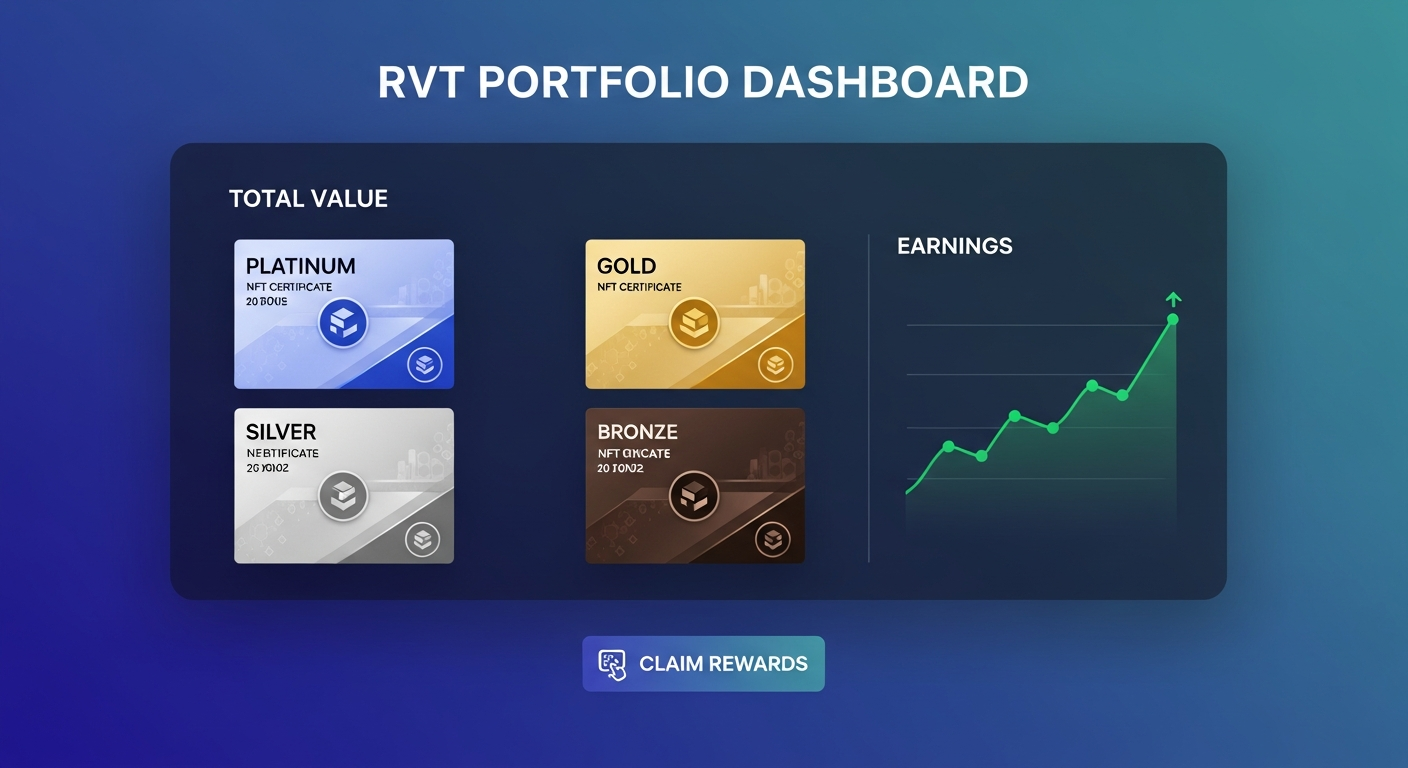
Figure 1: RVT portfolio dashboard showing holdings, tier distribution, and royalty earnings over time
How RVTs Differ from Traditional NFTs
Most people think of NFTs as digital art — a JPEG you buy and hope appreciates in value. RVTs are fundamentally different in several critical ways:
| Feature | Traditional NFTs | Kenostod RVTs |
|---|---|---|
| Value Source | Speculative / aesthetic | Real enterprise usage revenue |
| Income | None (unless resold at profit) | Perpetual royalty payments |
| Underlying Asset | Image, video, or metadata | Computational contribution record |
| Price Floor | Driven by hype and community | Driven by measurable revenue yield |
| Royalty Enforcement | Optional, often bypassed | On-chain, mandatory via smart contract |
| Utility | Social status, community access | Token rewards, governance rights |
RVTs bridge the gap between cryptocurrency and real-world income assets. They function more like dividend-paying stocks or rental properties than collectible trading cards. The value of an RVT is ultimately backed by the commercial demand for the computation it represents.
The RVT Lifecycle
Understanding the complete lifecycle of an RVT is essential for effective portfolio management:
-
Contribution
You contribute computing power, data labeling, model training, or validation work through the Kenostod network. The Proof of Residual Value (PoRV) consensus mechanism records and validates your contribution.
-
Minting
Based on the quality and value of your contribution, an RVT NFT is minted to your wallet. The tier level (Bronze through Diamond) is determined by the contribution's assessed value.
-
Commercial Usage
Enterprises purchase access to the AI models, datasets, or computational results your work helped produce. Each commercial usage event triggers the royalty distribution smart contract.
-
Royalty Distribution
The smart contract automatically calculates your share based on your RVT tier and distributes KENO tokens to your wallet. This happens in real-time with every usage event.
-
Secondary Market
You can hold your RVTs indefinitely for ongoing income, or sell them on the marketplace. When sold, royalty rights transfer to the new owner, but the original creator retains a small creator royalty.
ERC-721 vs ERC-1155 Token Standards
Before diving deeper into RVT portfolio management, it is essential to understand the two primary token standards used for NFTs on Ethereum-compatible blockchains. Kenostod's RVTs leverage aspects of both standards.
ERC-721: The Original NFT Standard
ERC-721 was the first widely adopted standard for non-fungible tokens, introduced in 2018. Each ERC-721 token has a unique token ID and is completely distinct from every other token in the same contract. This makes it ideal for one-of-a-kind assets.
ERC-1155: The Multi-Token Standard
ERC-1155, sometimes called the "multi-token standard," allows a single contract to manage both fungible and non-fungible tokens. This is more gas-efficient for collections where multiple copies of the same token type exist.
Which Standard Do Kenostod RVTs Use?
Kenostod RVTs use a hybrid approach. Each RVT is individually unique (like ERC-721) because it records a specific computational contribution, but the tiered system and batch operations borrow concepts from ERC-1155 for efficiency.
| Feature | ERC-721 | ERC-1155 | Kenostod RVT |
|---|---|---|---|
| Uniqueness | Each token unique | Fungible + non-fungible | Each token unique |
| Batch Transfers | One at a time | Multiple in one TX | Batch supported |
| Gas Efficiency | Higher per transfer | Lower per transfer | Optimized batching |
| Royalty Standard | EIP-2981 (optional) | EIP-2981 (optional) | Mandatory on-chain |
| Metadata | Per-token URI | Shared URI template | Per-token + tier data |
Understanding token standards helps you evaluate RVTs on different marketplaces. Some marketplaces only support ERC-721, others support ERC-1155, and Kenostod's native marketplace supports both. When trading RVTs on external marketplaces, verify they support the royalty enforcement mechanism — otherwise, you might purchase an RVT and not receive the expected royalties.
Kenostod's Five-Tier NFT System
Kenostod uses a five-tier system to categorize RVTs based on the value, complexity, and impact of the underlying computational contribution. Each tier carries a different royalty multiplier, affecting how much token rewards you earn.
🥉 Bronze
Standard tasks
1x Royalty
Data labeling, basic validation
🥈 Silver
Above-average
2x Royalty
Complex datasets, model testing
🥇 Gold
High-value
5x Royalty
ML model training, algorithm design
💎 Platinum
Exceptional
10x Royalty
Novel research, breakthrough models
💧 Diamond
Legendary
25x Royalty
Industry-transforming contributions
Tier Distribution and Rarity
Not all tiers are created equal in terms of supply. Rarity directly impacts both marketplace value and perceived prestige:
| Tier | Approx. Supply % | Royalty Multiplier | Typical Floor Price | Rarity Score |
|---|---|---|---|---|
| 🥉 Bronze | 50% | 1x | 50 – 200 KENO | Common |
| 🥈 Silver | 25% | 2x | 300 – 800 KENO | Uncommon |
| 🥇 Gold | 15% | 5x | 1,000 – 3,000 KENO | Rare |
| 💎 Platinum | 8% | 10x | 5,000 – 15,000 KENO | Epic |
| 💧 Diamond | 2% | 25x | 20,000+ KENO | Legendary |
Tier Upgrade Mechanics
Under certain conditions, your RVT tier can be upgraded. If the computational result your RVT represents becomes significantly more popular or generates unexpected commercial value, the PoRV consensus mechanism can trigger a tier promotion. For example, a Bronze RVT tied to a dataset that becomes the foundation of a widely-used AI model may be upgraded to Silver or even Gold.
Tier upgrades are permanent, but if the underlying computation is found to be plagiarized, corrupted, or otherwise invalid, the RVT can be burned (permanently destroyed). Always ensure your contributions are original and high-quality.
Perpetual Royalty Mechanics
The royalty mechanism is the heart of the RVT system. Unlike traditional creative royalties that often require intermediaries, legal agreements, and manual enforcement, Kenostod's royalty system is fully automated, on-chain, and perpetual.
How Royalties Are Calculated
When an enterprise pays to use a computational result (such as an AI model inference), the payment is split according to a predefined formula:
Comparison: RVT Royalties vs Traditional Royalty Income
To appreciate how revolutionary RVT royalties are, let's compare them to traditional royalty models:
| Aspect | Traditional Royalties | RVT Royalties |
|---|---|---|
| Payment Speed | Monthly/quarterly, often delayed | Real-time, per-usage event |
| Intermediaries | Publishers, agents, collecting societies | None — smart contract only |
| Transparency | Opaque; hard to audit | Fully transparent on blockchain |
| Enforcement | Requires legal action | Automatic via smart contract |
| Transferability | Complex contracts, lawyers needed | Instant NFT transfer on marketplace |
| Geographic Limits | Jurisdiction-dependent | Global, borderless |
| Duration | Contract-defined (often limited) | Perpetual (forever) |
Secondary Market Royalty Enforcement
One of the biggest challenges in the NFT industry is royalty enforcement on secondary sales. Many marketplaces have made creator royalties optional, allowing buyers and sellers to bypass them. Kenostod takes a different approach:
Kenostod RVTs embed royalty logic directly into the token's smart contract using an enhanced version of EIP-2981. When an RVT is transferred, the _beforeTokenTransfer hook automatically calculates and distributes the royalty payment. This means royalties cannot be bypassed, even on external marketplaces that attempt to skip them — the transfer will simply fail if the royalty is not paid.
How RVTs Enable Arbitrage Access
The primary financial appeal of RVTs is their ability to generate token rewards — money you earn without active work. Once your RVT is minted, it earns royalties automatically every time the underlying computation is used commercially. Here is how to think about the income potential:
Income Projection Example
Let's model a realistic scenario. Imagine you hold a portfolio of RVTs across different tiers:
Compounding Through Reinvestment
Smart RVT portfolio managers don't just collect royalties — they reinvest. By using royalty income to purchase additional RVTs on the marketplace, you create a compounding effect similar to dividend reinvestment in traditional finance.
If you earn 4,000 KENO/month and reinvest half (2,000 KENO) to buy additional Bronze RVTs at a floor price of 100 KENO each, you acquire 20 new Bronze RVTs per month. After one year, your additional Bronze holdings alone would generate an extra 2,000 KENO/month — a 50% increase in income from reinvestment.
Factors That Affect Royalty Income
Your royalty income is not fixed. It fluctuates based on several factors:
- Enterprise Adoption: More enterprises using your computation = more royalty events
- Total RVT Supply: More RVTs minted for the same computation = smaller individual share
- Seasonal Demand: Some industries have cyclical demand (e.g., retail AI peaks during holidays)
- KENO Token Price: Royalties are paid in KENO, so the fiat value depends on market price
- Network Growth: As Kenostod's enterprise customer base grows, overall royalty pools increase
NFT Portfolio Diversification Strategies
Like traditional investment portfolios, your RVT portfolio benefits enormously from thoughtful diversification. Concentrating all your holdings in a single tier, industry, or computation type exposes you to unnecessary risk.
Strategy 1: Tier Diversification
Spread your holdings across multiple tier levels. Lower tiers (Bronze, Silver) provide steady, reliable income from high-volume computations. Higher tiers (Gold, Platinum, Diamond) provide larger payouts but from fewer, more specialized use cases.
Conservative: 50% Bronze, 30% Silver, 15% Gold, 5% Platinum/Diamond
Balanced: 30% Bronze, 25% Silver, 25% Gold, 15% Platinum, 5% Diamond
Aggressive: 10% Bronze, 15% Silver, 30% Gold, 30% Platinum, 15% Diamond
Strategy 2: Industry Diversification
RVTs are tied to computations across different industries. Diversifying across industries protects you from sector-specific downturns:
- Healthcare AI: Medical imaging analysis, drug discovery models, patient data processing
- Financial Modeling: Risk assessment, fraud detection, algorithmic trading signals
- Climate Research: Weather prediction models, carbon tracking, environmental monitoring
- Supply Chain: Logistics optimization, demand forecasting, inventory management
- Creative AI: Content generation, language models, image recognition
Strategy 3: Temporal Diversification (Dollar-Cost Averaging)
Don't buy all your RVTs at once. Spread purchases over time to average out price fluctuations. This is especially important during volatile market conditions where floor prices can swing significantly.
Portfolio Rebalancing
Periodically review your RVT portfolio and rebalance. If one industry's RVTs have appreciated significantly, consider selling some to reinvest in underrepresented sectors. A quarterly review cycle is recommended for most investors.
Marketplace Mechanics & Valuation
The Kenostod RVT marketplace is where holders can buy, sell, and trade RVTs. Understanding marketplace mechanics is critical for making informed investment decisions.
Floor Price Dynamics
The floor price is the lowest listed price for any RVT in a given category. Floor prices are driven by several forces:
- Supply: More RVTs minted in a tier pushes floor prices down
- Demand: More buyers competing for scarce high-tier RVTs pushes floors up
- Royalty Yield: Higher-yielding RVTs command premium prices (buyers are paying for income)
- Market Sentiment: Overall crypto market conditions affect NFT prices broadly
- Enterprise Announcements: New enterprise partnerships increase demand for related RVTs
Valuation Methods
How do you determine the fair price of an RVT? There are several approaches:
1. Yield-Based Valuation
Calculate the annual royalty yield and compare it to alternative investments. If a Gold RVT generates 500 KENO/year in royalties and is priced at 2,000 KENO, the yield is 25%. Compare this to DeFi yields, staking rewards, or traditional dividend stocks.
2. Comparable Sales (Comps)
Look at recent sales of similar RVTs. What did the last Gold-tier Healthcare AI RVT sell for? Use this as a reference point, adjusting for differences in royalty history and computation popularity.
3. Discounted Cash Flow (DCF)
Project future royalty payments and discount them back to present value. This is the most sophisticated method and accounts for growth expectations, but requires assumptions about future enterprise usage.
Listing and Selling on the Marketplace
When you list an RVT for sale, you set your asking price. Buyers can either purchase at your price or make counter-offers. Key considerations when listing:
- Check the current floor price for your RVT's tier and industry
- Review your RVT's royalty history — higher-earning RVTs justify higher prices
- Factor in the marketplace fee (typically 2.5% on Kenostod's native marketplace)
- Consider using auction format for rare Platinum/Diamond RVTs to maximize price
Risk Management for NFT Portfolios
Every investment carries risk, and RVT portfolios are no exception. Understanding and managing these risks is what separates successful investors from those who lose money.
Types of Risk
1. Market Risk
The overall cryptocurrency market can experience significant downturns. Even if your RVTs continue generating the same amount of KENO in royalties, the fiat value of KENO itself may decline. Mitigation: Don't invest more than you can afford to lose, and consider converting some royalty income to stablecoins or fiat regularly.
2. Liquidity Risk
Higher-tier RVTs (Platinum, Diamond) may be difficult to sell quickly because there are fewer buyers at those price points. You might have to accept a lower price to sell quickly. Mitigation: Maintain a portion of your portfolio in Bronze and Silver RVTs, which have higher trading volume.
3. Smart Contract Risk
While Kenostod's smart contracts are audited, no code is 100% bug-free. A vulnerability could potentially affect royalty distribution or token transfers. Mitigation: Kenostod uses multi-audited contracts and has a bug bounty program, but stay informed about any security updates.
4. Computation Obsolescence Risk
The computational result your RVT represents could become outdated as newer, better models are developed. If enterprises stop using your computation, royalty income drops to zero. Mitigation: Diversify across multiple computations and industries.
5. Regulatory Risk
Governments may introduce regulations that affect NFT trading, royalty income taxation, or cryptocurrency markets broadly. Mitigation: Stay informed about regulations in your jurisdiction and consult a tax professional about reporting royalty income.
Never invest in RVTs based solely on someone else's recommendation, Discord hype, or promises of guaranteed returns. Always do your own research (DYOR). Legitimate RVTs have verifiable on-chain royalty history. If someone is selling an "exclusive Diamond RVT" at a steep discount via direct message, it is almost certainly a scam.
The 5% Rule
A common risk management guideline: never allocate more than 5% of your total investment portfolio to any single RVT or RVT category. This ensures that even a total loss on one position doesn't devastate your overall portfolio.
Real-World Case Studies
These real-world examples illustrate the opportunities and pitfalls of NFT-based income investing:
Case Study 1: The Bored Ape Yacht Club Floor Price Collapse
What happened: Bored Ape Yacht Club (BAYC) NFTs peaked at a floor price of ~100 ETH ($300,000+) in April 2022. By late 2023, the floor had dropped below 30 ETH, and by 2024 it fell under 10 ETH — a decline of over 90% from peak.
The lesson: NFTs driven primarily by hype, celebrity endorsements, and community sentiment (rather than underlying utility or income) can lose value rapidly. RVTs mitigate this risk because their value is tied to measurable enterprise revenue, not social status.
Case Study 2: Royalty Wars — OpenSea vs Blur
What happened: In late 2022, the NFT marketplace Blur launched with zero creator royalties, undercutting OpenSea. OpenSea responded by making royalties optional. Creators saw their royalty income collapse overnight, even though their NFTs were still being traded.
The lesson: Creator royalties are only as strong as their enforcement mechanism. Kenostod solves this by embedding mandatory royalty logic into the smart contract itself — the transfer fails if royalties aren't paid, regardless of which marketplace facilitates the sale.
Case Study 3: Music NFTs and Perpetual Royalties
What happened: Artists like Daniel Allan and RAC pioneered music NFTs that give holders a share of streaming royalties. Allan's "Overstimulated" EP raised 50 ETH, and holders continue to receive streaming income years later. This model proved that NFTs can be genuine income-generating assets.
The lesson: NFTs backed by real, recurring revenue streams retain value better than speculative collectibles. This is precisely the model Kenostod RVTs follow — but applied to enterprise computation rather than music streaming.
Case Study 4: The Importance of Portfolio Diversification (2022 Crypto Winter)
What happened: During the 2022 crypto winter, investors concentrated in a single NFT project (e.g., Moonbirds, Azuki, or Doodles) saw their portfolio value drop 80-95%. However, investors who diversified across multiple projects, utility types, and blockchains experienced much smaller drawdowns.
The lesson: Diversification is the closest thing to a "free lunch" in investing. Spreading your RVT holdings across tiers, industries, and time periods dramatically reduces risk.
Written Exercises
Complete these exercises to reinforce your understanding. Take your time — thoughtful answers demonstrate true comprehension.
Exercise 1: RVT vs Traditional NFT
Explain to a friend who only knows about "JPEG NFTs" what makes Kenostod's RVTs different. Use a real-world analogy (like owning rental property or a patent) to illustrate how RVTs generate perpetual income.
Exercise 2: Portfolio Allocation
You have 10,000 KENO to invest in RVTs. Design a portfolio allocation across the five tiers and at least three industries. Justify your choices in terms of risk tolerance, income goals, and diversification principles.
Exercise 3: Royalty Calculation
An enterprise pays 10,000 KENO for computation usage. The royalty pool has 100 Bronze (1x), 40 Silver (2x), 15 Gold (5x), 5 Platinum (10x), and 1 Diamond (25x) RVTs. Calculate: (a) the total weighted shares, (b) the royalty pool amount, and (c) how much a single Gold RVT holder earns from this payment.
Exercise 4: Risk Assessment
You discover a Diamond-tier RVT listed at 50% below its typical floor price. List at least four possible reasons for the discount and explain how you would investigate each one before deciding whether to buy.
Exercise 5: Token Standard Analysis
Explain why Kenostod chose to embed mandatory royalty enforcement directly into the smart contract rather than relying on marketplace-level enforcement (like EIP-2981). What are the advantages and potential drawbacks of this approach?
Final Exam (12 Questions)
You must score at least 10 out of 12 correct (80%) to complete this course and earn your 250 KENO reward. Take your time and review the material if needed.
Kenostod Blockchain Academy © 2024