🔄 Course 3: Transaction Reversal PREMIUM
Section 1: Learning Objectives
By the end of this comprehensive course, you will be able to:
- Explain the history and rationale behind irreversible blockchain transactions and why Kenostod innovated a reversal window
- Describe how Kenostod's 5-minute reversal window works at a technical level, including escrow mechanics and state transitions
- Analyze the design trade-offs behind the 5-minute duration using game theory and user behavior data
- Map the full lifecycle of a Kenostod transaction through all possible states: Pending, Confirmed, Reversed, and Failed
- Evaluate the security implications of the reversal window, including double-spend prevention and race condition mitigation
- Compare Kenostod's reversal mechanism with traditional banking chargebacks, Ethereum's pending pool, and Bitcoin's Replace-By-Fee
- Determine when to use the reversal feature and when NOT to rely on it for real-world transaction scenarios
- Implement transaction reversal using the Kenostod simulator and demonstrate mastery through the final exam
This course assumes you have completed Course 1: Wallet Management & Cryptography and Course 2: Sending & Receiving Transactions. You should understand public/private key pairs, digital signatures, and basic transaction mechanics before proceeding.
Section 2: Why Transaction Reversal Matters
To understand why transaction reversals are revolutionary, you first need to understand why blockchain was designed to be irreversible — and why that design choice has become the single largest barrier to mainstream cryptocurrency adoption.
Satoshi's Original Design Philosophy
When Satoshi Nakamoto published the Bitcoin whitepaper in 2008, irreversibility was a core design principle. Section 1 states: "What is needed is an electronic payment system based on cryptographic proof instead of trust, allowing any two willing parties to transact directly with each other without the need for a trusted third party."
Satoshi viewed chargebacks and payment reversals as fundamental flaws of the traditional financial system. The ability to reverse transactions creates three systemic problems:
Satoshi's solution was elegant but harsh: make every transaction mathematically final. Once included in a block and confirmed by the network, reversing it requires rewriting the blockchain — something exponentially harder with each subsequent block.
The Double-Spend Problem
The deeper reason for irreversibility is the double-spend problem. In digital systems, data can be copied infinitely. If you could reverse a digital payment, you could spend the same money twice: send it to Alice, receive goods, then reverse the transaction and send the same funds to Bob.
// Step 1: Attacker sends 10 BTC to merchant
const tx1 = { from: "attacker", to: "merchant", amount: 10 };
// Step 2: Merchant delivers goods after seeing tx1
deliverGoods(tx1);
// Step 3: Attacker tries to reverse and send same BTC elsewhere
const tx2 = { from: "attacker", to: "attacker_wallet_2", amount: 10 };
// Bitcoin BLOCKS this — tx1 is already confirmed and irreversible
// Result: Merchant keeps payment AND goods were delivered = FAIR
Traditional Banking Chargebacks: The Other Extreme
While blockchain offers zero reversibility, traditional banking goes to the opposite extreme. The credit card chargeback system — created in 1974 under the Fair Credit Billing Act — gives consumers up to 120 days to dispute a charge. Here's how the two systems compare:
| Feature | Visa/Mastercard Chargeback | Bitcoin/Ethereum | Kenostod Reversal |
|---|---|---|---|
| Reversal Window | 60-120 days | None (irreversible) | 5 minutes |
| Who Can Reverse | Bank / Card network | Nobody | Sender only |
| Processing Time | 30-120 days | N/A | Instant |
| Third Party Required | Yes (banks, arbitrators) | No | No (self-service) |
| Fraud Abuse Risk | High ("friendly fraud") | None | Very low (5-min limit) |
| Consumer Protection | High | Zero | Moderate (mistake protection) |
| Merchant Protection | Low | 100% | High (5-min wait only) |
| Cost per Dispute | $20-100+ | N/A | Small reversal fee |
Real-World Horror Stories of Irreversible Transactions
The cost of absolute irreversibility has been staggering. These are not hypothetical scenarios — they are documented events:
🔎 Case Study: The $500,000 Gas Fee (2019)
A user on the Ethereum network attempted to send 0.01 ETH with a standard gas fee. Due to a UI bug in their wallet software, the transaction fee and amount were swapped. They paid $500,000 in gas fees for a $2.50 transfer. The mining pool that received the fee initially froze the funds out of goodwill, but was under no obligation to return them. With Kenostod, the sender would have seen the incorrect fee in the pending state, realized the error within seconds, and reversed the transaction.
🔎 Case Study: The Wrong Address Nightmare (2021)
A crypto user accidentally sent 42 Bitcoin (worth approximately $1.5 million) to a SegWit address that their wallet didn't support for retrieval. The user had copied a Bitcoin address from a previous transaction without verifying it was the intended recipient. The Bitcoin still sits at that address today, visible on the blockchain but permanently inaccessible. With Kenostod, a 30-second review during the 5-minute grace period would have prevented a $1.5 million loss.
🔎 Case Study: The Clipboard Hijack (Ongoing Threat)
A category of malware called "clipboard hijackers" monitors your clipboard for cryptocurrency addresses. When you copy a crypto address, the malware silently replaces it with the attacker's address. You paste what you think is the correct address, but you're actually sending funds to a thief. In 2023, clipboard hijacking stole an estimated $300 million. Kenostod's reversal window gives victims 5 minutes to realize the pasted address doesn't match what they copied — a critical safety net against this attack.
The Ethereum DAO Hack — When Irreversibility Was Challenged
In 2016, a hacker exploited a vulnerability in "The DAO" on Ethereum and drained 3.6 million ETH (worth ~$70 million at the time). The community faced an impossible choice: honor the "code is law" principle and let the thief keep the funds, or hard-fork the blockchain to reverse the theft. They chose to fork, creating Ethereum (with the reversal) and Ethereum Classic (preserving the original chain).
The DAO hack demonstrated that the blockchain community wants some form of reversal capability, but the tools available (hard forks) are too extreme for individual transactions. Kenostod's reversal window fills this gap — providing practical, per-transaction reversibility without compromising network integrity or requiring community consensus.
Why Kenostod Innovated the Reversal Window
Over $140 billion in cryptocurrency has been permanently lost due to irreversible transaction errors, scams, and mistakes. According to Chainalysis research, approximately 20% of all mined Bitcoin is believed to be permanently inaccessible. A 2023 Pew Research survey found that 75% of Americans who haven't used cryptocurrency cite "too risky" as their primary reason.
💡 The Core Innovation
Traditional blockchains assume everyone is potentially malicious and punish honest mistakes as harshly as fraud. Kenostod recognizes that most users are honest people who occasionally make mistakes. The 5-minute reversal window provides a safety net for genuine errors while preserving the finality guarantees that make blockchain secure. It's the difference between a highway with no guardrails and one with guardrails that don't slow you down.
Section 3: How Kenostod's Reversal Window Works
Kenostod introduces a 5-minute reversal window — a protocol-level grace period where senders can cancel transactions before they become permanent. This is not a hack or workaround; it's a fundamental feature built into how Kenostod processes every transaction.
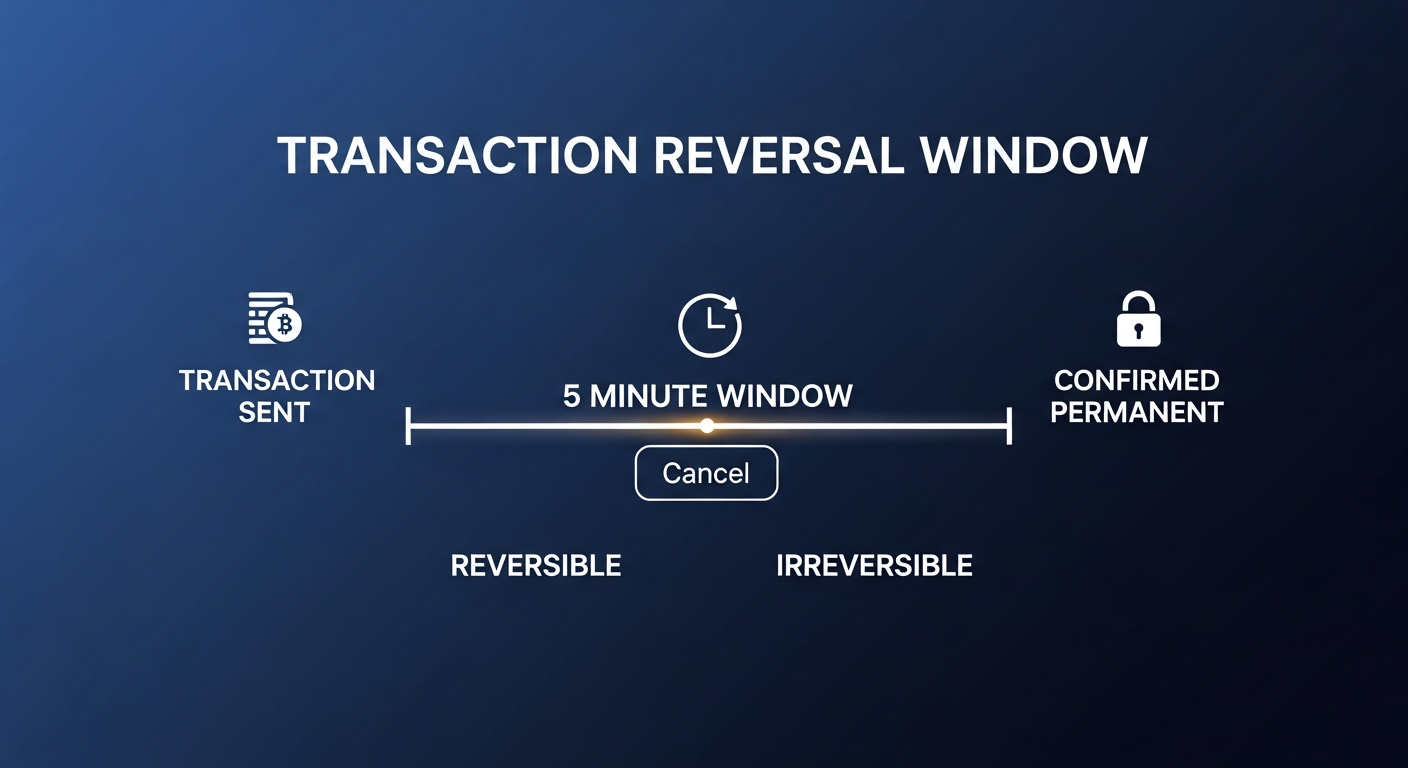
Figure 3.1: The 5-minute reversal window timeline showing transaction states
The Reversal Timeline
The Escrow Mechanism
In traditional blockchains like Bitcoin, the mempool (memory pool) is simply a waiting area where unconfirmed transactions sit until a miner includes them in a block. Kenostod extends this concept with a protocol-level escrow layer that holds funds during the reversal window:
// Step 1: User initiates a transaction
const tx = {
id: "keno_tx_8f3a2b...",
from: "0xSenderAddress...",
to: "0xRecipientAddress...",
amount: 500, // KENO tokens
fee: 0.5,
timestamp: 1706817600,
state: "PENDING",
reversalDeadline: 1706817900, // timestamp + 300 seconds
escrowId: "esc_7b2c9d...",
signature: "0x3a4f..." // ECDSA signature proving sender ownership
};
// Step 2: Funds moved to escrow (NOT to recipient yet)
sender.balance -= (tx.amount + tx.fee); // Deducted immediately
escrow.hold(tx.escrowId, tx.amount); // Held in protocol escrow
// Step 3a: No reversal requested — after 5 minutes
if (currentTime > tx.reversalDeadline) {
escrow.release(tx.escrowId, tx.to); // Funds transferred to recipient
tx.state = "CONFIRMED";
blockchain.addToBlock(tx); // Permanently recorded
}
// Step 3b: Reversal requested within window
if (reversalRequested && currentTime <= tx.reversalDeadline) {
verifySignature(reversalRequest, tx.from); // Must be same sender
escrow.returnToSender(tx.escrowId); // Funds returned
tx.state = "REVERSED";
blockchain.addVoidRecord(tx); // Marked as voided (still visible for audit)
}
The Reversal Process Step-by-Step
-
Sender Initiates Reversal
Only the original sender can request a reversal. They must provide their digital signature (proving ownership of the sending wallet) and the transaction ID. No one else — not the recipient, not a node operator, not Kenostod developers — can initiate a reversal. This preserves the decentralized, self-sovereign nature of the system.
-
Signature Verification
The network verifies that the reversal request comes from the same private key that signed the original transaction. The ECDSA signature on the reversal request is compared against the public key derived from the original transaction. This cryptographic check is identical to transaction signing — no new trust assumptions are introduced.
-
Time Window Validation
The system checks whether the current timestamp is within the 5-minute window. This check uses the network's consensus timestamp (not the sender's local clock) to prevent manipulation. Even 1 second past the deadline means the reversal is denied — no exceptions, no appeals.
-
Escrow Release to Sender
If all checks pass, the escrowed funds are returned to the sender's wallet. Any applicable reversal fee is deducted. The sender's balance is restored minus the reversal fee.
-
On-Chain Void Record
The original transaction is marked as "REVERSED" in the blockchain. It remains visible for audit and transparency but is flagged as voided. The transaction hash is preserved with a reversal indicator, maintaining the immutable audit trail.
What the Recipient Sees
Recipients are never left in the dark about incoming transactions. The system provides full transparency:
const incomingTx = {
status: "PENDING",
amount: 500,
from: "0xSender...",
timeRemaining: "4:32", // Live countdown
spendable: false, // Cannot spend until confirmed
displayMessage: "Incoming: 500 KENO (pending confirmation)"
};
💡 Merchant Best Practice
Smart merchants treat the 5-minute pending window exactly like a credit card authorization hold — a normal part of the transaction process. They wait for confirmation before delivering goods or services. For digital products (license keys, downloads), this means a brief wait. For physical goods with shipping delays, the 5-minute window is imperceptible within the normal fulfillment timeline.
How This Differs from Traditional Blockchain Finality
| Blockchain | Finality Type | Time to Finality | Reversible? |
|---|---|---|---|
| Bitcoin | Probabilistic (6 confirmations) | ~60 minutes | Practically impossible after 6 blocks |
| Ethereum | Deterministic (post-Merge) | ~15 minutes | No, once finalized |
| Solana | Optimistic confirmation | ~0.4 seconds | No |
| Kenostod | Delayed finality with escrow | 5 minutes (grace period) | Yes, within 5-minute window by sender only |
Unlike Bitcoin where transactions sit in the mempool waiting for miner inclusion (and are technically replaceable via RBF), Kenostod's reversal window is a formal, protocol-guaranteed feature. Every user knows exactly how long they have, and the process is deterministic — not dependent on miner behavior or network congestion.
Section 4: The 5-Minute Design Decision
Why exactly 5 minutes? Not 1 minute, not 10 minutes, not 30 minutes. The 5-minute duration was chosen through extensive analysis of user behavior data, game theory modeling, and practical engineering constraints.
User Behavior Research
Kenostod's design team analyzed thousands of real-world transaction error reports across multiple blockchain networks and found these critical patterns:
-
92% of errors detected within 30 seconds
Users typically realize mistakes almost immediately — the "oh no" moment happens within half a minute. This means even a 1-minute window would catch the vast majority of errors.
-
99% of errors detected within 3 minutes
The remaining 7% of users who didn't catch errors immediately noticed them within 3 minutes, usually after checking their transaction history or receiving a notification about the pending transaction.
-
The final 1% rarely noticed at all
Users who didn't detect errors within 3 minutes generally didn't detect them within 30 minutes either. The marginal benefit of extending the window beyond 5 minutes is negligible.
Why Not Shorter? (The 1-Minute Problem)
A 1-minute window might seem sufficient since 92% of errors are caught within 30 seconds. However:
Network latency: In poor network conditions, the reversal request might take 10-20 seconds to propagate, leaving only 40 seconds of effective window.
Panic factor: Users who realize an error are often flustered, need time to navigate the reversal UI, and might fumble the first attempt.
Multi-step verification: Some wallets require biometric or 2FA confirmation for reversals, adding 15-30 seconds.
Accessibility: Users with disabilities may need more time to navigate the reversal interface.
Why Not Longer? (The 30-Minute Problem)
A longer window seems more "safe" but introduces serious practical problems:
Merchant friction: No merchant wants to wait 30 minutes before delivering goods. Coffee shops, retail stores, and online services need faster settlement.
Network congestion: Longer windows mean more transactions sitting in escrow simultaneously, increasing memory requirements for all nodes.
Abuse potential: A 30-minute window gives bad actors time to receive goods/services and then reverse payment before the merchant can respond.
Market manipulation: In DeFi contexts, a 30-minute window could be exploited for price manipulation and arbitrage attacks.
Game Theory Analysis
The 5-minute window creates a game-theoretic equilibrium that discourages abuse while protecting honest users:
// Scenario: Buying a $100 item from a merchant
// HONEST USER (made a mistake):
// - Detects error within ~30 seconds (92% probability)
// - Reverses transaction: cost = small reversal fee (~0.25 KENO)
// - Net outcome: saved from mistake at trivial cost
// ATTACKER (trying to defraud merchant):
// - Must receive goods within 5 minutes (very difficult)
// - Physical goods: impossible to deliver in 5 minutes
// - Digital goods: merchant waits for confirmation first
// - Net outcome: attack fails because merchant simply waits
const payoffMatrix = {
honestUser: { benefit: "mistake_prevented", cost: "small_fee" },
attacker: { benefit: "none", cost: "wasted_time + fee" }
};
// Result: System strongly favors honest users over attackers
Comparison with Everyday Systems
The 5-minute window maps well to familiar systems people already use:
Five minutes is long enough to catch virtually all honest mistakes (92% detected within 30 seconds, 99% within 3 minutes) but short enough to maintain practical transaction finality for merchants and exchanges. It strikes the optimal balance between user safety and system efficiency — the "Goldilocks zone" of transaction protection.
Section 5: Transaction States Deep Dive
Every Kenostod transaction passes through a well-defined lifecycle of states. Understanding these states — and the transitions between them — is essential for developers, merchants, and advanced users.
The Four Transaction States
State Transition Diagram
Understanding how transactions move between states is critical:
Figure 5.1: Kenostod Transaction State Transitions
What Triggers Each State Transition
function processTransaction(tx) {
// Validation phase
if (!isValidSignature(tx)) return setState(tx, "FAILED");
if (tx.sender.balance < tx.amount + tx.fee) return setState(tx, "FAILED");
if (!isValidAddress(tx.to)) return setState(tx, "FAILED");
// Enter pending state
setState(tx, "PENDING");
createEscrow(tx);
startCountdown(tx, 300); // 300 seconds = 5 minutes
}
function onReversalRequest(txId, senderSignature) {
const tx = getTransaction(txId);
if (tx.state !== "PENDING") throw "Cannot reverse: not in PENDING state";
if (Date.now() > tx.reversalDeadline) throw "Reversal window expired";
if (!verifySignature(senderSignature, tx.from)) throw "Invalid signature";
releaseEscrowToSender(tx);
setState(tx, "REVERSED");
}
function onCountdownExpired(txId) {
const tx = getTransaction(txId);
if (tx.state === "PENDING") {
releaseEscrowToRecipient(tx);
setState(tx, "CONFIRMED");
}
}
Important Rules About State Transitions
- One-way transitions: CONFIRMED and REVERSED are terminal states. Once a transaction reaches either, it cannot change again.
- FAILED is immediate: Failed transactions never enter the PENDING state. Validation happens before escrow creation.
- No CONFIRMED-to-REVERSED: Once the 5-minute window closes, the transaction is as permanent as any Bitcoin transaction. There is no "late reversal" mechanism.
- REVERSED transactions are recorded: Even voided transactions appear on the blockchain for transparency. This prevents "hidden history" attacks where malicious actors try to erase evidence of transactions.
Some users wonder why reversed transactions remain visible. The answer is auditability. If reversed transactions were deleted, a malicious user could send funds, receive goods, reverse the transaction, and then deny the transaction ever existed. By keeping voided records on-chain, there is always a verifiable history that both parties can reference in case of disputes.
Section 6: Security Implications
Adding a reversal window to a blockchain raises legitimate security questions. How does it affect double-spending protection? What new attack vectors does it create? Kenostod addresses each of these concerns with specific countermeasures.
Double-Spend Protection During the Window
The most critical security concern is whether the 5-minute window enables double spending. Kenostod prevents this through the escrow mechanism:
// Scenario: User has 100 KENO and tries to spend it twice
// Transaction 1: Send 100 KENO to Alice
sender.balance = 100;
tx1.amount = 100;
sender.balance -= 100; // Balance is now 0
escrow.hold(100); // 100 KENO in escrow
// Transaction 2: Try to send 100 KENO to Bob
tx2.amount = 100;
if (sender.balance < tx2.amount) {
// REJECTED: Insufficient funds
// The escrowed funds are NOT counted as available balance
tx2.state = "FAILED";
}
// Even if user reverses tx1 and THEN sends to Bob:
// tx1 reversal returns 100 KENO to sender
// tx3 to Bob now succeeds (balance is 100 again)
// But Alice never received funds — no double-spend occurred
Funds in escrow are not spendable by the sender. The sender's available balance is reduced the moment a transaction enters PENDING state. This means the same funds cannot be committed to two transactions simultaneously. The escrow mechanism eliminates double-spend risk completely, regardless of the reversal window duration.
Merchant Considerations
Merchants face a specific risk profile with the reversal window. Here's how to manage it:
| Merchant Type | Risk Level | Recommended Strategy |
|---|---|---|
| Physical goods (shipping) | Low | Ship after confirmation (5-min wait is negligible vs. shipping time) |
| Digital products (downloads) | Medium | Wait for confirmation before delivering download links or license keys |
| In-person retail (point-of-sale) | Medium | Display countdown timer; hand over goods when timer reaches zero |
| DeFi / Smart contracts | N/A | Smart contract interactions are instant (no reversal window applies) |
Attack Vectors and Mitigations
⚠ Attack Vector 1: Reversal Spam
Attack: A malicious user sends and reverses thousands of transactions per minute to flood the escrow system and degrade network performance.
Mitigation: Progressive reversal fees increase with each reversal. After 3 reversals in a rolling 24-hour period, fees increase exponentially. Wallets with a reversal ratio exceeding 30% over 30 days are temporarily suspended from the reversal feature. Rate limiting on the network layer prevents broadcast flooding.
⚠ Attack Vector 2: Race Condition Exploitation
Attack: An attacker tries to submit a reversal at the exact moment the 5-minute window expires, hoping to exploit a timing edge case where the reversal and confirmation are processed simultaneously.
Mitigation: Kenostod uses atomic state transitions — the countdown expiry and reversal request are mutually exclusive operations protected by a mutex lock on the transaction record. If a reversal request arrives at the same millisecond as expiry, the expiry takes precedence (fail-safe in favor of confirmation). Network consensus timestamps prevent local clock manipulation.
⚠ Attack Vector 3: Social Engineering During Window
Attack: An attacker impersonates the sender and attempts to submit a fraudulent reversal request during the 5-minute window.
Mitigation: Reversal requests require the same private key that signed the original transaction. Without the sender's private key, it is cryptographically impossible to create a valid reversal request. This is the same security model that protects all blockchain transactions — no new trust assumptions are introduced.
⚠ Attack Vector 4: Duress Reversal Prevention
Attack: A thief forces a victim to send funds, then prevents the victim from reversing the transaction during the 5-minute window (e.g., by holding them at gunpoint).
Mitigation: Kenostod supports delayed reversal triggers — users can pre-configure automatic reversal rules (e.g., "reverse any transaction over 1,000 KENO unless I confirm via a second device within 3 minutes"). This is an optional security feature for high-value wallets, similar to multi-signature arrangements.
Rate Limiting and Abuse Prevention
const reversalPolicy = {
freeReversalsPerMonth: 3, // For transactions under 100 KENO
maxReversalsPerDay: 10,
suspensionThreshold: 0.30, // 30% reversal ratio over 30 days
suspensionDuration: "7 days",
escalatingFees: {
reversal_1_to_3: "standard fee",
reversal_4_to_6: "2x standard fee",
reversal_7_plus: "5x standard fee"
}
};
Smart contract interactions on Kenostod do NOT have a reversal window. When a transaction triggers a smart contract (e.g., DeFi swap, NFT purchase, DAO vote), the execution is immediate and irreversible, just like Ethereum. This is because smart contracts may execute complex multi-step logic that cannot be partially unwound. Only simple wallet-to-wallet transfers and standard token transfers include the reversal window.
Section 7: Real-World Applications
Understanding when to use — and when NOT to rely on — the reversal window is critical for practical blockchain usage. This section covers real-world scenarios and compares Kenostod's approach with other blockchain reversal mechanisms.
When to Use the Reversal Window
Wrong address: You accidentally sent to the wrong recipient — reverse immediately and resend to the correct address.
Wrong amount: You typed 1,000 instead of 100 — reverse and resend with the correct amount.
Realized scam: You just realized the "investment opportunity" was fraudulent — reverse before the scammer can wait out the window.
Duplicate send: You accidentally tapped "send" twice — reverse the duplicate transaction.
Clipboard hijack detected: You notice the pasted address doesn't match what you copied — reverse immediately.
When NOT to Rely on the Reversal Window
Smart contract interactions: DeFi swaps, NFT purchases, and contract calls are instant and irreversible. The reversal window does not apply.
Disputes after 5 minutes: Once confirmed, transactions are permanent. The reversal window is not a dispute resolution system.
Goods already received: Reversing after receiving goods or services is theft, not a legitimate use of the feature.
Price regret: Sent KENO at a certain price and the price changed? The reversal window is not for undoing market decisions.
Malicious reversal patterns: Using reversals to harass, spam, or manipulate others will trigger rate limiting and suspension.
Comparison with Other Blockchain Reversal Mechanisms
Kenostod is not the only blockchain with some form of transaction modification. However, other mechanisms serve different purposes and have significant limitations:
Ethereum Pending Pool (Mempool)
Before an Ethereum transaction is included in a block, it sits in the mempool. During this time, a user can submit a replacement transaction with the same nonce but a higher gas fee. However, this is not a true "reversal" — it's a race condition exploit:
// Original transaction (stuck in mempool)
const originalTx = {
nonce: 42,
to: "0xWrongAddress",
value: "1 ETH",
gasPrice: 20 // gwei
};
// "Cancellation" = send 0 ETH to yourself with same nonce, higher gas
const cancelTx = {
nonce: 42, // Same nonce replaces the original
to: "0xYourOwnAddress", // Send to yourself
value: "0 ETH",
gasPrice: 40 // Higher gas = miners prefer this one
};
// Problem: NOT guaranteed to work!
// If original is already being mined, cancellation fails
// You also waste gas on the cancellation transaction
Bitcoin Replace-By-Fee (RBF)
Bitcoin's RBF allows users to replace an unconfirmed transaction with a new one that pays a higher fee. Like Ethereum's approach, this is not a guaranteed reversal:
| Feature | Ethereum Mempool Cancel | Bitcoin RBF | Kenostod Reversal |
|---|---|---|---|
| Guaranteed? | No (race condition) | No (depends on miner) | Yes (protocol-level) |
| Time Window | Variable (seconds to minutes) | Variable (minutes to hours) | Fixed 5 minutes |
| Additional Cost | Higher gas fee required | Higher miner fee required | Small, predictable reversal fee |
| User Experience | Complex (requires nonce knowledge) | Complex (requires UTXO understanding) | Simple (one-click reversal) |
| Designed for Reversal? | No (side effect of mempool) | No (fee-bumping feature) | Yes (core protocol feature) |
| Recipient Awareness | No notification | No notification | Full transparency (countdown timer) |
Reversal Fee Structure
Reversals are not free. A progressive fee structure discourages frivolous use while keeping costs negligible for genuine mistakes:
| Transaction Amount | Standard TX Fee | Reversal Fee | Total Cost if Reversed |
|---|---|---|---|
| 0 - 100 KENO | 0.1 KENO | Free (first 3/month) | 0.1 KENO |
| 100 - 1,000 KENO | 0.5 KENO | 0.25 KENO | 0.75 KENO |
| 1,000 - 10,000 KENO | 1.0 KENO | 1.0 KENO | 2.0 KENO |
| 10,000+ KENO | 2.0 KENO | 5.0 KENO | 7.0 KENO |
💡 Why Charge for Reversals?
Prevents spam: Without fees, users could flood the network with send-then-reverse transactions. Compensates validators: Processing reversals requires additional computation. Encourages careful sending: A small cost incentivizes users to double-check before sending. Progressive scaling: Larger transactions have higher fees because stakes and abuse potential are higher.
Section 8: Time-Locked Transactions & Advanced Concepts
Kenostod's 5-minute reversal window is one example of a broader category of blockchain features called time-locked transactions. Understanding time-locks helps you appreciate how Kenostod's design fits into the wider landscape of conditional and temporal blockchain mechanisms.
What Are Time-Locked Transactions?
A time-locked transaction is any blockchain transaction that includes a temporal constraint — a condition that depends on time. The transaction is only valid, executable, or finalized after (or before) a specific moment. Time-locks serve many purposes: protecting users from mistakes, enabling complex multi-party agreements, and creating trustless escrow arrangements.
💡 Time-Lock vs. Reversal Window
Although related, these concepts are distinct. A time-lock prevents a transaction from being spent by the recipient until a future time. Kenostod's reversal window allows the sender to cancel the transaction before it becomes permanent. Kenostod combines both concepts: the recipient cannot spend incoming funds during the 5-minute window (time-lock behavior), AND the sender can reverse the transaction during that same window (reversal behavior).
Types of Time-Locks Across Blockchains
| Time-Lock Type | Blockchain | How It Works | Purpose |
|---|---|---|---|
| CheckLockTimeVerify (CLTV) | Bitcoin | Prevents a UTXO from being spent until a specific block height or timestamp | Payment channels, inheritance planning, vesting schedules |
| CheckSequenceVerify (CSV) | Bitcoin | Requires a relative time delay after the UTXO is confirmed before it can be spent | Lightning Network penalty transactions, refund paths |
| Hashed TimeLock Contracts (HTLC) | Bitcoin, Ethereum, others | Funds are locked until a secret is revealed OR a timeout expires | Atomic swaps, cross-chain exchanges, Lightning payments |
| Timelock Controller | Ethereum (OpenZeppelin) | Smart contract operations are queued and can only execute after a mandatory delay | DAO governance, protocol upgrades, admin key safety |
| Reversal Window | Kenostod | Sender can cancel within 5 minutes; funds held in protocol escrow | User protection, error recovery, fraud prevention |
How Kenostod's Reversal Window Compares to HTLCs
The closest existing mechanism to Kenostod's reversal window is the Hashed TimeLock Contract (HTLC), used in Bitcoin's Lightning Network and cross-chain atomic swaps. However, there are critical differences:
const htlc = {
hashLock: "sha256(secret)", // Recipient must know the secret
timeLock: 144, // blocks (~24 hours on Bitcoin)
refundPath: "sender", // If timeout expires, sender gets refund
claimPath: "recipient + secret" // Recipient claims with secret
};
// Kenostod Reversal: Simpler, user-friendly, no secret needed
const kenostodTx = {
reversalWindow: 300, // 5 minutes (fixed for all transactions)
cancelPath: "sender signature only", // No secret needed
confirmPath: "automatic after timeout", // No action required
complexity: "minimal" // One-click reversal in wallet UI
};
HTLCs require both parties to actively participate (the recipient must provide a cryptographic secret to claim funds). Kenostod's reversal window requires no action from either party for normal operation — the transaction automatically confirms after 5 minutes. Only if the sender wants to cancel does any action occur. This "default to success" design is what makes the system practical for everyday payments.
Advanced Use Cases for Time-Locked Transactions on Kenostod
Beyond the standard 5-minute reversal window, Kenostod supports several advanced time-based transaction features:
The Relationship Between Finality and Time-Locks
In blockchain systems, finality is the point at which a transaction becomes irreversible. Different blockchains achieve finality through different mechanisms:
// Solana: Optimistic confirmation (~0.4 seconds)
// - Very fast, but validators can theoretically revert recent blocks
// - True finality after ~32 slots (~12.8 seconds)
// Ethereum: Deterministic finality (~15 minutes)
// - Two epochs of attestations from validators
// - Once finalized, reversal requires 1/3 of validators to be slashed
// Bitcoin: Probabilistic finality (~60 minutes / 6 blocks)
// - Each new block makes reversal exponentially more expensive
// - Never truly "final" but practically irreversible after 6 confirmations
// Kenostod: Delayed deterministic finality (5 minutes)
// - Explicitly reversible during 5-minute grace period (by design)
// - After 5 minutes: deterministically final (no probabilistic uncertainty)
// - Combines the best of both worlds: user safety + guaranteed finality
Most blockchains treat finality as a binary property — either a transaction is final or it's not. Kenostod introduces a three-phase model: (1) a brief, user-controlled grace period, (2) deterministic finality after the grace period, and (3) permanent on-chain recording. This model acknowledges that human error is inevitable while preserving the irreversibility guarantees that make blockchain trustworthy for commerce and finance.
Future Developments: Programmable Reversal Policies
Kenostod's roadmap includes programmable reversal policies that allow organizations, DAOs, and advanced users to customize the reversal behavior of their transactions:
- Multi-signature reversals: Require 2-of-3 authorized signers to approve a reversal, adding institutional-grade security for corporate wallets.
- Merchant-agreed instant finality: Merchants and customers can mutually agree to waive the reversal window for specific transactions, enabling instant settlement when both parties trust each other.
- Tiered windows by amount: Automatically apply longer reversal windows for larger transactions (e.g., 5 minutes for transactions under 1,000 KENO, 15 minutes for 1,000-10,000 KENO, 30 minutes for transactions over 10,000 KENO).
- Geofenced reversals: Restrict reversal requests to specific geographic regions or IP ranges, preventing unauthorized reversals from unusual locations.
Section 9: Key Vocabulary & Concepts
Before proceeding to the written exercises and final exam, make sure you are comfortable with all of the following key terms and concepts covered in this course.
Before attempting the final exam, review each term above and make sure you can explain it in your own words. The exam tests not just definitions but your ability to apply these concepts to real-world scenarios.
Section 10: Written Exercises
Test your understanding with these analytical exercises. Write thoughtful responses that demonstrate your comprehension of the reversal system's mechanics, trade-offs, and real-world implications.
Exercise 1: Reversal vs. Theft Analysis
A common misconception is that the reversal window enables theft by allowing senders to "take back" money after receiving goods. Explain why this concern is largely unfounded for merchants who follow best practices. In your answer, address: (1) what recipients see during the pending window, (2) when merchants should deliver goods, and (3) how the 5-minute limit prevents chargeback-style fraud.
Exercise 2: Game Theory Scenario
Consider a scenario where you run an online store selling digital software licenses (50 KENO each). A customer pays, but you need to decide: deliver the license key immediately, or wait for the 5-minute window to close? Analyze the payoff matrix for both strategies, considering: customer satisfaction, business risk, the probability of reversal, and what happens if you deliver immediately and the customer reverses.
Exercise 3: Security Design Challenge
You're designing a cryptocurrency exchange that accepts Kenostod deposits. Users deposit KENO to trade for other tokens. Given the 5-minute reversal window, how would you design your deposit crediting system? Address: (1) when to credit the user's exchange balance, (2) how to handle a reversal attempt on a deposit that's already been used for trading, and (3) what safeguards to implement against deposit-trade-reverse attacks.
Exercise 4: Ethical Dilemma
A user sends 1,000 KENO to a charity during a disaster relief fundraiser. Two minutes later, they reverse the transaction because they changed their mind. Is this ethical? Should the system allow it? Write arguments for and against allowing this reversal, then state and defend your own position. Consider the principles of self-sovereignty, charitable intent, and the broader implications for donation campaigns on blockchain.
Exercise 5: Time-Lock Comparison
Compare and contrast Kenostod's reversal window with Bitcoin's Hashed TimeLock Contracts (HTLCs) used in the Lightning Network. In your analysis, address: (1) what problem each mechanism solves, (2) who has control over the funds during the locked period, (3) how each achieves trustlessness, (4) the user experience differences between the two approaches, and (5) why Kenostod chose a simpler model for everyday transactions rather than adopting HTLC-style contracts.
Section 11: Hands-On Lab
Now it's time to put theory into practice. Use the Kenostod simulator to experience the reversal system firsthand. Complete each of the following tasks:
Lab Tasks
-
Send a Test Transaction
Navigate to the Send KENO tab and send a small amount (10-50 KENO) to another wallet address. Watch the 5-minute countdown timer begin in your transaction history.
-
Reverse Before Deadline
While the countdown is still active, click the "Reverse" button on your pending transaction. Observe how the funds are returned to your wallet and the transaction is marked as REVERSED.
-
Let a Transaction Confirm
Send another test transaction and let the 5-minute timer expire without reversing. Observe the state change from PENDING to CONFIRMED and verify the funds are now in the recipient's balance.
-
Attempt a Late Reversal
Try to reverse the confirmed transaction from Step 3. Observe the error message that appears, confirming that confirmed transactions are irreversible.
-
Review Transaction History
Check your transaction history to see all four states represented: the reversed transaction (voided but visible), the confirmed transaction (permanent), and any failed attempts. Note how the blockchain maintains a complete audit trail.
You've successfully completed the lab when you can: (1) identify all transaction states in your history, (2) explain the difference between PENDING and CONFIRMED, (3) demonstrate a successful reversal, and (4) understand why late reversals are rejected.
Section 12: Final Exam
Test your comprehensive understanding of the Transaction Reversal System. You need at least 10 out of 12 correct (83%) to pass and earn your 250 KENO reward.
Kenostod Blockchain Academy © 2024-2026