🔐 Course 5: Social Recovery System NEW PREMIUM
Learning Objectives
By the end of this comprehensive course, you will be able to:
- Understand the scale of cryptocurrency lost due to key management failures
- Compare traditional recovery methods with blockchain-specific challenges
- Explain how social recovery works using guardian networks and threshold signatures
- Describe Vitalik Buterin's proposal for social recovery wallets
- Analyze how Argent wallet implements social recovery in production
- Design an optimal guardian selection strategy
- Identify and defend against attack vectors targeting recovery systems
- Compare social recovery with seed phrases, custodial services, and Shamir's Secret Sharing
- Set up guardians for your Kenostod wallet and complete a recovery process
- Design an inheritance plan using social recovery guardians
- Evaluate real-world case studies of successful and failed recoveries
- Understand how ERC-4337 account abstraction will shape the future of wallet recovery
The Graveyard of Lost Cryptocurrency
Before we dive into solutions, it's essential to understand the staggering scale of the problem that social recovery addresses. The history of cryptocurrency is littered with stories of lost fortunes, each one representing a human tragedy that could have been prevented.
The Numbers Are Staggering
According to blockchain analytics firm Chainalysis, approximately 3.7 million Bitcoin — roughly 20% of all Bitcoin ever mined — are believed to be permanently lost. At Bitcoin's peak price, this represents over $250 billion in inaccessible wealth. This isn't theoretical value; these are real coins sitting in real wallets that no one can ever access again.
The situation extends beyond Bitcoin:
- Ethereum: An estimated 500,000+ ETH (worth billions) is locked in contracts or wallets with lost keys
- Hardware wallet failures: Thousands of users have lost access due to broken devices without proper seed backups
- Exchange collapses: Mt. Gox (2014), QuadrigaCX (2019), FTX (2022) — billions lost because a single person or entity controlled the keys
- Death without succession: An unknown amount of cryptocurrency dies with its owners, as families have no way to access inherited crypto
- Accidental disposal: Hard drives, USB sticks, and paper wallets thrown away containing millions in cryptocurrency
The Landfill Bitcoin
Perhaps the most famous lost cryptocurrency story belongs to James Howells, a Welsh IT worker who accidentally threw away a hard drive containing 8,000 Bitcoin in 2013. At the time, the Bitcoin was worth about $4 million. By 2024, the hard drive — now buried under tons of garbage in a Newport, Wales landfill — contains Bitcoin worth over $500 million. Howells has been fighting the local council for years to excavate the landfill, offering to share the proceeds, but has been repeatedly denied permission due to environmental concerns.
Howells has even proposed a plan involving robotic dogs, AI sorting systems, and a dedicated team of excavation workers, estimated to cost $11 million. The council's response remains unchanged: no excavation permitted. The Bitcoin sits there still, a monument to the impermanence of human memory.
The Cryptographic Inheritance Problem
When Gerald Cotten, CEO of Canadian exchange QuadrigaCX, died unexpectedly in December 2018 while traveling in India, he reportedly took the only copies of the cold wallet private keys with him. Over $190 million in customer cryptocurrency became permanently inaccessible. An investigation by Ernst & Young later revealed the situation was more complex — Cotten had actually been misusing customer funds for years — but the case highlighted a very real and fundamental problem: cryptocurrency has no built-in mechanism for inheritance or succession.
A Timeline of Major Losses
2010 — Early Bitcoin Deletions
Hundreds of early miners casually deleted wallets containing thousands of BTC, worth pennies at the time but now worth fortunes. One Reddit user famously deleted a wallet with 8,999 BTC (worth over $600 million today).
2013 — James Howells' Landfill
8,000 BTC thrown in the trash. The hard drive remains buried in a Welsh landfill to this day.
2014 — Mt. Gox Collapse
850,000 BTC (approximately $450 million at the time) stolen or lost from the world's largest Bitcoin exchange. Creditors waited over a decade for partial recovery.
2017 — Parity Wallet Bug
A bug in the Parity multi-sig wallet library locked 513,774 ETH (about $150 million at the time) permanently. The funds remain frozen in the smart contract to this day because no recovery mechanism existed.
2019 — QuadrigaCX
$190 million in customer crypto became inaccessible when the CEO died with the only copies of the private keys.
2022 — FTX Collapse
Over $8 billion in customer funds lost due to mismanagement and fraud at one of the world's largest exchanges. A stark reminder that custodial solutions carry enormous counterparty risk.
Cryptocurrency was created to give people sovereign control over their money — no bank, no government, no third party can seize your funds. But this same property means that if you lose your key, no one can help you. You are simultaneously the most secure and the most vulnerable custodian of your own wealth. Social recovery resolves this paradox by creating a middle ground: you maintain sovereignty under normal conditions, but have a safety net when things go wrong.
Why Traditional Backup Methods Fail
Users have tried many approaches to safeguard their keys, and each has fundamental flaws:
The Lost Key Problem in Depth
In traditional cryptocurrency, losing your private key or seed phrase means losing access to your funds forever. There is no "forgot password" link, no customer support number, and no court order that can restore access. The cryptography is absolute — even the combined computing power of every computer on Earth working for billions of years cannot crack a single private key.
"Not your keys, not your coins" is a common crypto mantra. But the flip side is equally true: "Lose your keys, lose your coins." This creates an impossible choice between security and recoverability. Store your keys with a third party (exchange) and risk losing everything if they're hacked or go bankrupt. Store them yourself and risk losing everything if you make a human error.
The Traditional Finance Safety Net
In traditional banking, account recovery is straightforward. Forgot your password? Reset it. Lost your debit card? Order a new one. Bank goes under? FDIC insurance covers up to $250,000. Someone steals your identity? The bank reverses fraudulent charges. Every step of the way, there's a human institution that can intervene.
Cryptocurrency deliberately removed these intermediaries. That was the entire point — no one can freeze your account, reverse your transactions, or inflate away your savings. But this also means no one can help you when things go wrong. Social recovery aims to restore the safety net without restoring the intermediary.
Problems with Seed Phrases
The current standard for key backup — the 12 or 24-word seed phrase — has several critical weaknesses:
-
Easy to Lose
Paper gets damaged by water, fire, or simple aging. Digital copies can be accidentally deleted, corrupted, or lost in hardware failures. The average person moves 11 times in their lifetime — plenty of opportunities to misplace a piece of paper. Studies show that 29% of crypto users have misplaced their backup at least once.
-
Easy to Steal
Anyone who finds your seed phrase owns your funds — no password, no 2FA, no verification required. A house cleaner, a repair technician, a curious family member, or a burglar who knows to look for it can drain your entire wallet in seconds. The seed phrase is a bearer instrument — possession equals ownership.
-
No Partial Recovery
Unlike a password (which can be partially remembered and brute-forced), a seed phrase requires ALL words in the EXACT order. Missing even one word makes recovery computationally infeasible (2,048 possible words per position, yielding 2,048 combinations to check for one missing word, but exponentially more for multiple missing words). There's no "close enough" in cryptography.
-
Inheritance is Nearly Impossible
How do you pass crypto to your heirs? If you include the seed phrase in your will, it becomes a public document upon probate — anyone at the courthouse can see it. If you give it to your lawyer, you're trusting a third party with full access. If you don't tell anyone, the funds die with you. There's no elegant solution within the seed phrase model.
-
User Error is the #1 Threat
The most common causes of seed phrase loss are remarkably mundane: accidentally throwing away the paper, forgetting where it was stored, misreading handwriting (was that a 'g' or 'q'?), resetting devices without backing up first, and confusing the order of words. These aren't exotic attacks — they're everyday human mistakes that have cost people their life savings.
💡 The Key Insight
The seed phrase model asks humans to behave like computers: store arbitrary information perfectly, indefinitely, and securely. But humans are not computers. We forget things, we make mistakes, and we die. Any security system built on the assumption that humans are perfectly reliable is fundamentally broken. Social recovery acknowledges human fallibility and designs around it.
Recovery Methods Compared
Before diving into social recovery specifically, let's survey the landscape of key recovery approaches and understand the tradeoffs each makes.
Shamir's Secret Sharing (SSS)
Shamir's Secret Sharing, invented by cryptographer Adi Shamir in 1979, splits a secret (like a private key) into N parts, where any K parts can reconstruct the original (K-of-N threshold). For example, split your key into 5 shares, give one to each of 5 trusted people, and any 3 shares can reconstruct the key.
const privateKey = "0x4f3c..."; // The secret to protect
// Split into 5 shares, 3 needed to reconstruct
const shares = shamirSplit(privateKey, {
totalShares: 5,
threshold: 3
});
// Result: 5 share fragments
// share1: "801a3f..." → give to Alice
// share2: "802b4e..." → give to Bob
// share3: "803c5d..." → give to Charlie
// share4: "804d6c..." → store in safe deposit box
// share5: "805e7b..." → give to lawyer
// To recover: ANY 3 shares reconstruct the key
const recovered = shamirCombine([shares[0], shares[2], shares[4]]);
// recovered === privateKey — full access restored!
Pros: Mathematically elegant, no single point of failure, information-theoretically secure (fewer than K shares reveal zero information about the secret).
Cons: Requires an offline ceremony to split and distribute shares. Shares are static — if you want to change guardians, you must generate entirely new shares and redistribute them all. The reconstructed key exists in memory during recovery, creating a brief vulnerability window. Shareholders must coordinate to recover, which is difficult if the key owner is incapacitated.
Multi-Signature Wallets (Multisig)
Multisig wallets require multiple private keys to authorize transactions. Unlike SSS, the keys are never combined — each signer independently signs, and the smart contract validates that enough signatures are present.
Pros: No single key can steal funds, no key combination ceremony needed, widely supported on Ethereum and Bitcoin.
Cons: All signers must actively participate in every transaction (not just recovery). Higher gas costs on Ethereum. Not user-friendly for everyday use. If used for personal wallets, requires carrying multiple devices.
Custodial Recovery (Exchanges/Banks)
The simplest approach: let a trusted institution hold your keys. If you lose access, they verify your identity and restore it — just like a bank reissuing a debit card.
Pros: Familiar UX, password resets work, customer support available, regulatory protections (in some jurisdictions).
Cons: Completely defeats the purpose of self-sovereign cryptocurrency. Your funds can be frozen, seized, or lost if the custodian goes bankrupt (Mt. Gox, FTX). You're trusting a single entity with total control. "Not your keys, not your coins."
Social Recovery (The Smart Wallet Approach)
Designate trusted guardians who can collectively authorize a key replacement — without ever having access to your funds under normal conditions.
Pros: No single point of failure, guardians don't have fund access during normal operation, dynamic (add/remove guardians anytime without ceremony), time-lock protection against unauthorized recovery, combines self-sovereignty with safety net. A new key is generated rather than recovering the old one.
Cons: Requires maintaining social relationships with guardians, guardians could theoretically collude, introduces social engineering attack surface, requires smart contract wallet (not just an EOA).
Comprehensive Comparison Table
| Feature | Seed Phrase Only | Shamir's SSS | Multisig | Custodial | Social Recovery |
|---|---|---|---|---|---|
| Single Point of Failure | Yes (the paper) | No | No | Yes (the custodian) | No |
| Self-Sovereign | Yes | Yes | Partially | No | Yes |
| Dynamic Guardians | N/A | No (regenerate shares) | Difficult | N/A | Yes |
| Time-Lock Protection | No | No | Optional | Sometimes | Yes (48 hours) |
| Key Exposure During Recovery | Yes (full key) | Yes (briefly) | No | No | No (new key generated) |
| Everyday Usability | Good | Poor | Poor | Excellent | Good |
| Complexity | Low | High | High | Low | Medium |
| Inheritance Support | Poor | Moderate | Moderate | Good | Excellent |
| Cost | Free | Free | Higher gas fees | Exchange fees | Minimal gas |
Vitalik Buterin's Social Recovery Vision
In January 2021, Ethereum co-founder Vitalik Buterin published a landmark blog post titled "Why we need wide adoption of social recovery wallets". This essay laid out the intellectual foundation for social recovery as the future of wallet security and directly influenced Kenostod's design philosophy.
Vitalik's Core Argument
Buterin argued that the crypto community faces a false dilemma between two bad options:
- Option A: Use a centralized exchange (easy to use, but not your keys — not your coins)
- Option B: Self-custody with seed phrase (your keys, but one mistake and you lose everything)
His thesis: Social recovery wallets offer Option C — the security and sovereignty of self-custody combined with the recoverability of custodial solutions. He called them "the clear winner" for long-term wallet design.
"My argument is simple: we need to move to a world where smart contract wallets are widely adopted, and the primary security model is social recovery... Social recovery wallets provide a high level of security and much better usability than any existing alternative." — Vitalik Buterin, January 2021
The Smart Contract Wallet Model
Vitalik proposed that wallets themselves should be smart contracts (not just keypairs). This is a fundamental paradigm shift. A traditional wallet is just a private key that signs transactions. A smart contract wallet is a programmable entity that can enforce complex rules — including recovery logic:
contract SocialRecoveryWallet {
address public owner;
address[] public guardians;
uint public threshold; // e.g., 3 of 5
uint constant RECOVERY_DELAY = 48 hours;
struct Recovery {
address newOwner;
uint approvals;
uint executeAfter;
bool active;
}
Recovery public pendingRecovery;
// Normal operation: only owner can transact
function execute(address to, uint amount, bytes data) external {
require(msg.sender == owner, "Only owner");
require(!pendingRecovery.active, "Wallet frozen");
// Execute transaction normally
}
// Recovery: guardians vote for new owner
function approveRecovery(address newOwner) external {
require(isGuardian(msg.sender), "Not guardian");
pendingRecovery.approvals++;
if (pendingRecovery.approvals >= threshold) {
pendingRecovery.executeAfter = block.timestamp + RECOVERY_DELAY;
pendingRecovery.active = true;
}
}
// Owner can cancel fraudulent recovery
function cancelRecovery() external {
require(msg.sender == owner, "Only owner");
delete pendingRecovery;
}
// After delay, finalize recovery
function finalizeRecovery() external {
require(pendingRecovery.active, "No active recovery");
require(block.timestamp >= pendingRecovery.executeAfter, "Delay not passed");
owner = pendingRecovery.newOwner;
delete pendingRecovery;
}
}
Key Design Principles from Vitalik
Why Vitalik Called It "The Clear Winner"
Buterin evaluated all existing wallet designs and concluded that social recovery wallets uniquely solve the full set of challenges:
- No single point of failure: Unlike seed phrases, losing one thing doesn't lose everything
- Low mental overhead: No need to memorize or securely store 24 words
- Recoverable: Unlike pure self-custody, you can recover from human error
- Self-sovereign: Unlike exchanges, no one controls your funds but you
- Future-proof: Compatible with account abstraction and evolving standards
Argent Wallet & Real-World Implementations
While Vitalik provided the theoretical framework, Argent built the first widely-used production implementation of social recovery on Ethereum. Understanding Argent's approach provides critical real-world insight into how social recovery works at scale.
How Argent Works
Argent is a mobile-first smart contract wallet launched in 2020. Every Argent wallet is a smart contract on Ethereum (not just a keypair), which enables programmable recovery logic. Here's how their system operates:
-
Smart Contract Wallet Creation
When you create an Argent wallet, a smart contract is deployed to Ethereum. This contract holds your funds and enforces access rules. Your phone holds a signing key, but the contract is the true "wallet." If your phone is lost, the contract — and your funds — remain on the blockchain.
-
Guardian Assignment
You designate guardians who can collectively change the signing key. Argent offers three types of guardians: (1) other Argent users, (2) hardware wallets like Ledger or Trezor, and (3) Argent's own institutional guardian service (called "Argent Guard"). Most users set up 2-3 guardians.
-
Daily Use Remains Simple
Under normal conditions, you use your wallet exactly like any other mobile wallet. Sign transactions with your phone's biometrics (fingerprint or Face ID). Guardians are invisible — they never see your transactions, balance, or activity.
-
Recovery When Needed
If you lose your phone, install Argent on a new device and initiate recovery. Guardians receive push notifications to approve. Once the threshold is met, a 36-hour security period begins. After the delay, your new device becomes the controller.
Argent's Guardian Types
| Guardian Type | How It Works | Pros | Cons |
|---|---|---|---|
| Argent Guard (Institutional) | Argent's own service verifies via email/phone OTP | Always available, automated | Trusts Argent as a company |
| Another Argent User | Friend/family with their own Argent wallet | Personal verification, free | Must also use Argent |
| Hardware Wallet | A Ledger or Trezor device you own | Self-sovereign, offline | If you lose the HW wallet too, useless |
Argent's Success in Numbers
Since launch, Argent has demonstrated that social recovery works at scale:
- Over 500,000 wallets created with social recovery enabled
- Thousands of successful recoveries completed, with zero reported fund losses due to the recovery mechanism itself
- Average recovery time: under 4 hours (including guardian coordination + security delay)
- The most common recovery scenario: lost or stolen phone (not hack attempts)
Other Implementations
Argent is not alone. Several other projects have implemented social recovery or similar guardian-based systems:
💡 Lesson from Argent
Argent proved that social recovery is not just a theoretical concept — it works in production with real users and real money. Their key insight: the best recovery system is one that's set up by default, not one that users must opt into. Kenostod follows this same philosophy, making guardian setup part of the initial wallet creation flow.
The Guardian System
The guardian system is the core innovation of social recovery. It creates a network of trusted entities who can collectively restore your access without having any individual power over your funds.
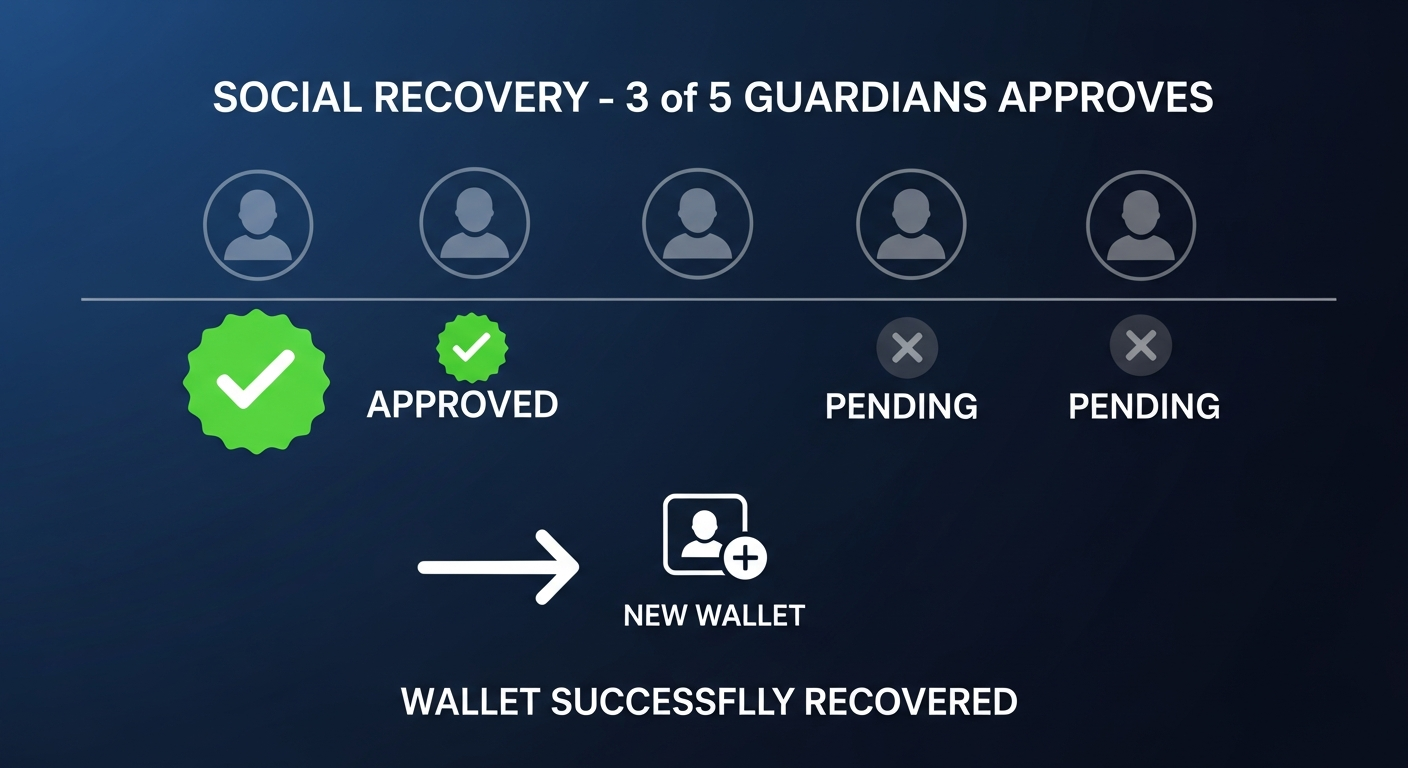
Figure: Guardian network protecting your wallet — 3 of 5 guardians required for recovery
How Guardians Work
-
Designate Guardians (3-7 people/entities)
You choose between 3 and 7 trusted parties to serve as your guardians. Each guardian is identified by their Kenostod wallet address. They don't need to install any special software — they just need a Kenostod wallet. The on-chain record stores guardian addresses as hashed values for privacy.
-
Set the Threshold (M of N)
You decide how many guardians must approve a recovery. Common setups include 2-of-3, 3-of-5, or 4-of-7. The threshold should be high enough to prevent collusion but low enough that you can actually reach enough guardians in an emergency. As a rule of thumb, set the threshold to just over half your total guardians.
-
Guardians Cannot Access Your Funds
This is the critical innovation: guardians have ZERO ability to view your balance, initiate transactions, or access your wallet in any way during normal operation. Their only power is to approve key replacement requests during a formal recovery process. This is fundamentally different from giving someone a copy of your key.
-
Recovery-Only Activation
Guardian powers are dormant until a recovery process is formally initiated on-chain. Even then, they can only vote to approve a new key — they cannot choose which key, access funds during the process, or override the time lock. Think of them as notaries, not co-owners.
💡 Threshold Cryptography: The Mathematics of Trust
Using "M of N" thresholds (like 3 of 5), the system achieves a mathematical property: no combination of fewer than M guardians reveals any information about your key or has any power to initiate recovery. This is based on threshold signature schemes, a branch of cryptography that allows a group to collectively perform an operation without any individual member having enough information to perform it alone. It's similar to how nuclear launch codes require two separate officers to turn their keys simultaneously — neither key alone does anything.
Guardian Roles and Responsibilities
As a guardian, your responsibilities are minimal but important:
- Stay reachable: Keep your contact information up to date with the wallet owner
- Verify identity: If a recovery request arrives, personally verify the requester's identity before approving
- Act promptly: When contacted for a legitimate recovery, respond within 24 hours
- Never share: Don't tell others that you are a guardian for a specific wallet
- Be skeptical: If something feels wrong about a recovery request, don't approve. Ask more questions.
The Recovery Process: Step by Step
When you lose access to your wallet — whether due to a lost device, forgotten credentials, or hardware failure — here's exactly what happens during recovery:
-
Initiate Recovery Request
You (from a new device or wallet) or someone acting on your behalf initiates a recovery request on the Kenostod network. This request specifies the wallet to be recovered and a new public key that should become the new owner. The request is broadcast to the network and to all designated guardians. Anyone can initiate a recovery request for any wallet, but it requires guardian approval to proceed.
-
Guardian Notification
All guardians receive a notification (push notification, email, or in-app alert depending on their settings) that a recovery request has been filed for your wallet. The notification includes the wallet address being recovered, the requested new owner address, and a timestamp.
-
Guardian Identity Verification
Each guardian independently verifies that the recovery request is legitimate. This happens off-chain through whatever method the guardian prefers: a phone call, a video call, an in-person meeting, or a pre-arranged verification protocol (such as a secret code word). The guardian must be personally satisfied that the request is genuine before approving.
-
Guardian Approval (On-Chain)
Once satisfied, each guardian submits an approval transaction to the network, signed with their own private key. The network tracks how many approvals have been received. When the threshold is met (e.g., 3 of 5 guardians approve), the recovery moves to the next phase.
-
48-Hour Time Lock Begins
Even after threshold approval, the recovery doesn't execute immediately. A 48-hour mandatory waiting period begins. During this time, the wallet is frozen — no one can move funds. If you (the original owner) still have access to the old key, you can cancel the recovery. This protects against social engineering attacks where someone tricks your guardians.
-
Key Rotation Completes
After 48 hours with no cancellation, the wallet's controlling key is rotated to the new public key. The old key is permanently invalidated. All funds, scheduled payments, and wallet settings transfer to the new key's control. You regain full access to your wallet from your new device.
The 48-hour delay between guardian approval and actual recovery is your last line of defense. If an attacker somehow convinces your guardians to approve a fraudulent recovery (through impersonation, social engineering, or coercion), you have 48 hours to notice the notification and cancel the recovery using your existing key. This window has prevented numerous unauthorized recovery attempts in testing and real-world deployments.
What Happens to Your Wallet During Recovery?
During the recovery process (from initiation through the 48-hour time lock):
- Funds are frozen: No one (not you, not the attacker, not anyone) can move funds until the recovery completes or is cancelled
- Scheduled payments pause: Any active scheduled payments are temporarily paused to prevent unauthorized execution
- Full audit trail: Every action during the recovery process is logged on-chain for transparency
- Guardian approvals are visible: Anyone can see which guardians have approved, maintaining accountability
- Notifications sent: The original wallet address receives push and email notifications about the recovery attempt
Recovery Flow Diagram
T+0h → Recovery initiated by new device
T+1h → Guardian 1 verifies identity, approves
T+3h → Guardian 2 verifies identity, approves
T+6h → Guardian 3 verifies identity, approves
T+6h → Threshold met (3/5) — 48h clock starts
T+6h to T+54h → Wallet FROZEN — cancellation window
T+54h → Recovery finalizes — new key active
T+54h → Old key permanently invalidated
Kenostod's Social Recovery System
Kenostod implements social recovery as a protocol-level feature, meaning every wallet has built-in social recovery capability without needing to deploy individual smart contracts. This approach offers several advantages over contract-level implementations like Argent.
Protocol-Level vs. Contract-Level Recovery
| Feature | Contract-Level (Argent) | Protocol-Level (Kenostod) |
|---|---|---|
| Deployment Cost | Gas fee per wallet (~$20-50) | No extra cost — built in |
| Universal Availability | Only wallets that deploy the contract | Every Kenostod wallet |
| Upgrade Path | Requires contract migration | Protocol updates apply to all |
| Gas Cost for Recovery | Multiple on-chain transactions | Single protocol-level operation |
| Complexity | Users must understand smart contracts | Abstracted — simple UI |
Kenostod-Specific Features
By building recovery into the protocol itself, Kenostod ensures that every single user benefits from social recovery — not just technically sophisticated users who know to deploy a smart contract wallet. This is the difference between optional safety features and mandatory seatbelts. Kenostod's approach means that social recovery "just works" for everyone.
Setting Up Guardians in Kenostod
const wallet = await kenostod.getWallet();
// Add guardians by their wallet addresses
await wallet.addGuardian("0xAlice...address");
await wallet.addGuardian("0xBob...address");
await wallet.addGuardian("0xCharlie...address");
await wallet.addGuardian("0xDiana...address");
await wallet.addGuardian("0xInstitutional...address");
// Set threshold: 3 of 5 required for recovery
await wallet.setRecoveryThreshold(3);
// Optionally configure custom time lock
await wallet.setRecoveryDelay(72 * 60 * 60); // 72 hours
// Verify setup
const config = await wallet.getRecoveryConfig();
console.log(config);
// { guardians: 5, threshold: 3, delay: 259200 }
Guardian Selection Best Practices
Choosing the right guardians is the most important decision in setting up social recovery. A poorly chosen guardian set can be worse than no recovery at all.
The Golden Rules of Guardian Selection
-
Choose Guardians Who Don't Know Each Other
If your guardians know each other, they could potentially collude to initiate a fraudulent recovery. Ideally, each guardian exists in a separate social circle. Your college friend, your cousin, and your work colleague are better choices than three people from the same friend group. This creates independent verification points that are difficult for an attacker to compromise simultaneously.
-
Geographic Distribution
Spread your guardians across different locations, ideally different cities or countries. This protects against localized disasters (natural disasters, political unrest) and makes it harder for a physical attacker to reach multiple guardians. It also helps with timezone diversity — at least one guardian is likely to be awake at any given time.
-
Mix Individual and Institutional Guardians
Combine personal contacts (friends, family) with institutional guardians (a lawyer, a guardian service, a hardware wallet company's recovery service). Institutions provide stability (they won't move, change phone numbers, or have falling-outs with you), while individuals provide personal verification (they can verify your identity through personal knowledge).
-
Choose Reliable, Not Wealthy, People
Your guardian doesn't need to be rich or tech-savvy, but they need to be reliable and reachable. Someone who always answers their phone and responds to messages within 24 hours is a better guardian than a wealthy friend who's constantly traveling and unreachable.
-
Consider Long-Term Relationships
Guardians should be people you expect to maintain contact with for years. Close friends from school, family members, and long-term professional contacts are ideal. Avoid choosing romantic partners (relationships end), new acquaintances (you don't know them well enough), or very elderly relatives (they may become unable to help).
Recommended Guardian Configurations
| Wallet Value | Recommended Setup | Example Guardian Mix |
|---|---|---|
| Under 1,000 KENO | 2-of-3 | 2 friends + 1 family member |
| 1,000 - 10,000 KENO | 3-of-5 | 2 friends + 1 family + 1 institutional + 1 colleague |
| 10,000 - 100,000 KENO | 4-of-7 | 2 friends + 2 family + 2 institutional + 1 lawyer |
| Over 100,000 KENO | 5-of-9 | 3 friends + 2 family + 2 institutional + 1 lawyer + 1 accountant |
Pre-Arranged Verification Protocols
Establish verification methods with each guardian before you need them. Examples of strong verification protocols:
- Secret question: "What's the name of my first dog?" — only you and this guardian know the answer
- Code word: A pre-agreed word or phrase that must be mentioned during the recovery request
- Video call requirement: Never approve a recovery without a live video call
- In-person meeting: For high-value wallets, require at least one guardian to meet you face-to-face
- Multi-channel verification: Contact via both phone AND email — compromising both is much harder
Never choose all guardians from the same family (they could collude or all be affected by the same event). Never choose someone who has a financial incentive to steal your funds. Never tell guardians who the other guardians are. Never use fake identities as guardians. Never skip the guardian setup "because you'll do it later" — that's when disasters happen.
Maintaining Your Guardian Network
Setting up guardians is not a one-time event. You should:
- Annual review: Confirm each guardian is still reachable and willing to serve
- Life event updates: Replace guardians after divorces, falling-outs, moves, or deaths
- Test recoveries: Periodically initiate and cancel test recovery requests to verify your guardians respond
- Rotation: Replace 1-2 guardians every 2-3 years to maintain freshness of relationships
Inheritance Planning with Social Recovery
One of the most powerful applications of social recovery is solving the crypto inheritance problem — ensuring your digital assets can be passed to your heirs without compromising security during your lifetime.
The Crypto Inheritance Crisis
Traditional assets have well-established inheritance mechanisms: bank accounts have beneficiary designations, real estate transfers through probate, and stock portfolios can be managed by executors. Cryptocurrency has none of these. Without explicit planning, crypto dies with its owner.
A 2023 survey by Cremation Institute estimated that 89% of crypto holders have no inheritance plan for their digital assets. Given that the average crypto holder is young and healthy, many assume they have time to figure it out. But accidents, sudden illness, and unexpected death are, by definition, unexpected.
Why Seed Phrases Fail for Inheritance
Social Recovery as an Inheritance Solution
Social recovery elegantly solves all of these problems. Here's a recommended inheritance planning strategy:
-
Include Heirs as Guardians (Not Sole Guardians)
Make your intended heirs (children, spouse, etc.) some of your guardians. In a 3-of-5 setup, you might include your spouse and two adult children as 3 of your 5 guardians. They can't individually access your funds, but collectively they can initiate recovery after your death.
-
Include a Professional Guardian
Add your estate lawyer or accountant as a guardian. They serve as a neutral party who can verify the legitimacy of an inheritance claim and ensure proper legal processes are followed. Their participation prevents unauthorized recoveries during your lifetime.
-
Document the Process (Not the Keys)
Store written instructions with your estate documents explaining: (1) that you hold cryptocurrency, (2) that it is protected by social recovery, (3) who the guardians are, and (4) step-by-step instructions for initiating recovery. Crucially, these instructions contain no keys or secrets — they're safe to store in a will or with a lawyer.
-
Practice While Alive
Have your heirs practice the recovery process while you're alive and can supervise. Initiate a recovery, let them experience the guardian notification and approval flow, then cancel it before it completes. This ensures they understand the process and can execute it when needed.
During your lifetime, your heirs are guardians but cannot access your funds (even if they collude, the 48-hour time lock gives you time to cancel). After your death, they can collectively initiate and approve a recovery, transferring the wallet to a designated heir. The time lock still applies (protecting against fraud), but since the original owner can no longer cancel, the recovery will complete. No seed phrases to find, no passwords to crack, no trust in a single third party.
Example Inheritance Configuration
// Family Guardians (3)
Guardian 1: Spouse
Guardian 2: Adult Child #1
Guardian 3: Adult Child #2
// Professional Guardians (2)
Guardian 4: Estate Lawyer
Guardian 5: Financial Advisor/Accountant
// Independent Guardians (2)
Guardian 6: Trusted Long-Term Friend
Guardian 7: Sibling or Extended Family
// Threshold: 5 of 7 required
// For inheritance: Spouse + 2 children + lawyer + 1 other = 5
// During lifetime: Even if all 3 family members collude,
// they need 2 more (lawyer + friend) — much harder
// Plus you can cancel within 48 hours
Attack Vectors & Security Considerations
No security system is perfect. Understanding potential attack vectors helps you defend against them. Social recovery introduces its own unique attack surface that differs from traditional key management threats.
Guardian Collusion Attack
Social Engineering Attack
Guardian Unavailability
Denial-of-Service (Nuisance) Attack
The $5 Wrench Attack
Bribery Attack
No single defense is sufficient. Security best practice is defense in depth — layering multiple protections so that an attacker must overcome several independent barriers. In social recovery, this means: diverse guardians (social layer) + time locks (protocol layer) + verification protocols (human layer) + rate limiting (technical layer) + guardian privacy (information layer). An attacker would need to simultaneously compromise all five layers to succeed.
The Future: Account Abstraction & ERC-4337
Social recovery is powerful today, but it's about to become even more significant with the rise of account abstraction — a fundamental upgrade to how blockchain accounts work. ERC-4337, finalized in March 2023, is the Ethereum standard that makes this possible.
What is Account Abstraction?
Today, Ethereum has two types of accounts:
- EOA (Externally Owned Account): Controlled by a private key. This is the traditional wallet. Simple but rigid — it can only do what a private key allows.
- Contract Account: A smart contract that holds funds. Programmable but currently requires an EOA to initiate transactions (and pay gas).
Account abstraction blurs this distinction. It allows smart contract wallets to act as first-class accounts — initiating transactions, paying gas in any token, and implementing custom validation logic. This means wallets can be programmed with social recovery, spending limits, session keys, and more — all as native features.
How ERC-4337 Works
ERC-4337 introduces a new transaction flow called "UserOperations" that allows smart contract wallets to function without needing a separate EOA:
User → Private Key signs tx → Blockchain executes
// ERC-4337 Flow (Account Abstraction)
User → UserOperation created → Bundler packages
→ EntryPoint contract validates → Smart wallet executes
// The validation step is programmable!
// It can check: signature, guardian approval,
// biometrics, spending limits, time restrictions...
Why ERC-4337 Supercharges Social Recovery
| Capability | Before ERC-4337 | With ERC-4337 |
|---|---|---|
| Gas Payment | Must hold ETH to initiate recovery | Paymaster can sponsor gas (gasless recovery) |
| Wallet Creation | Requires ETH for contract deployment | Counterfactual deployment (free until first use) |
| Recovery UX | Guardian must submit on-chain tx | Guardian can sign off-chain, bundler submits |
| Multi-Chain | Recovery per-chain | Cross-chain recovery possible via bundlers |
| Additional Security | Limited to key-based auth | Biometrics, passkeys, session keys, spending limits |
The Account Abstraction Ecosystem
Several major projects are building on ERC-4337 with social recovery as a core feature:
Passkeys & WebAuthn: The Future of Guardian Approval
Account abstraction enables a revolutionary UX improvement: guardians can approve recovery using passkeys (biometric authentication built into modern devices). Instead of managing private keys, guardians simply use their fingerprint or Face ID to approve a recovery — no crypto knowledge required.
// Guardian's device shows notification:
// "Alice requests wallet recovery. Approve?"
// Guardian authenticates with Face ID / fingerprint
const credential = await navigator.credentials.get({
publicKey: {
challenge: recoveryChallenge,
allowCredentials: [guardianCredential]
}
});
// Signed approval sent to bundler → on-chain
// No private keys, no gas, no crypto knowledge needed
💡 Kenostod's Roadmap
Kenostod is actively integrating ERC-4337 capabilities. Future updates will include: gasless guardian approvals (guardians won't need to hold any tokens), passkey-based guardian authentication (approve with a fingerprint), cross-chain recovery (recover wallets on multiple chains simultaneously), and social recovery for smart contract interactions (not just fund transfers). The goal is to make social recovery so seamless that users forget it's there — until they need it.
Real-World Case Studies
Case Study 1: The Argent Wallet Success Story
Background: Argent is one of the first production wallets to implement social recovery on Ethereum. Since launching in 2020, they've processed thousands of successful recoveries.
What happened: A user's phone was stolen while traveling abroad in Thailand. They purchased a new phone, installed Argent, and initiated recovery. Two of their three guardians (a friend back home and Argent's own guardian service) approved the recovery within 2 hours. After the time lock period, the user regained full access to their wallet from the new device — all while still abroad with no access to their original phone.
Key takeaway: Social recovery works in practice, not just in theory. The inclusion of an institutional guardian (Argent Guard) ensured availability even when the user was in a different timezone from their personal contacts. The user lost a phone but kept every token.
Case Study 2: The Stefan Thomas Tragedy (What Could Have Been)
Background: Stefan Thomas, a German programmer living in San Francisco, received 7,002 Bitcoin as payment for creating an explainer video about Bitcoin in 2011. He stored them in an IronKey encrypted USB drive.
What happened: Thomas forgot the password and had only 10 attempts before the drive permanently encrypts its contents. After 8 failed attempts, he stopped trying. The 7,002 BTC (worth over $400 million at Bitcoin's peak) remained locked. He has 2 attempts remaining and lives with the knowledge of his inaccessible fortune. He has described the experience as deeply traumatic, checking the Bitcoin price every day knowing the money is there but unreachable.
With social recovery: If Thomas had used a social recovery wallet, losing the password would have been a minor inconvenience. He would contact his guardians, verify his identity, wait 48 hours, and receive a new key to access his funds. Total loss: zero. Total time: about 3 days. Instead, he lives with $400 million locked behind 2 remaining password guesses.
Case Study 3: The Failed Social Engineering Attack
Background: In a documented test case from a security audit, researchers attempted to social-engineer guardians into approving a fraudulent recovery for a wallet containing test funds.
What happened: The researchers created a convincing story about an "emergency" and contacted the guardians claiming to be the wallet owner. They used a spoofed phone number and even created a fake social media account. Two out of three guardians initially believed the story and were ready to approve. However, the third guardian insisted on a video call, which the researchers couldn't provide. The third guardian then alerted the other two, who withdrew their approvals.
Key takeaway: Guardian verification protocols are critical. Even one vigilant guardian can prevent a social engineering attack. Pre-arranged verification codes and mandatory video/voice confirmation are essential safeguards. The system's security is only as strong as the most careful guardian.
Case Study 4: Crypto Inheritance Done Right
Background: A crypto investor set up a 3-of-5 guardian system with guardians including their spouse, sibling, lawyer, accountant, and a trusted childhood friend.
What happened: When the investor passed away unexpectedly from a cardiac event, the family was able to initiate a recovery process. The spouse, sibling, and lawyer (3 of 5 guardians) approved the recovery, transferring the wallet to the spouse's control. The entire process took 3 days (1 day for coordination + 48-hour time lock). The accountant and friend weren't even needed.
Key takeaway: Social recovery elegantly solves the crypto inheritance problem. Unlike seed phrases (which must be found and decoded) or custodial services (which may not recognize inheritance claims), guardian-based recovery provides a clear, reliable path for asset succession. The family didn't need to search for any papers, crack any passwords, or contact any exchanges.
Case Study 5: The Parity Wallet Freeze — A Cautionary Tale
Background: In November 2017, a user accidentally destroyed the Parity multi-sig wallet library contract, freezing 513,774 ETH (approximately $150 million at the time) across 587 wallets. The funds were not stolen — they were simply locked in contracts that could no longer function.
What happened: Because the affected wallets were simple multi-sig contracts without a recovery mechanism, there was no way to rescue the funds. The Ethereum community debated an EIP (Ethereum Improvement Proposal) to recover the funds through a protocol-level change, but it was ultimately rejected — modifying the blockchain to rescue funds would undermine the immutability that makes Ethereum trustworthy.
Key takeaway: This case demonstrates why smart contract wallets need robust, pre-built recovery mechanisms. Social recovery would have allowed the affected wallet owners to migrate to new contracts. The $150 million remains frozen to this day — a permanent reminder that recovery must be designed in from the start, not retrofitted after a disaster.
Written Exercises
Complete these exercises to reinforce your understanding. Take your time — thoughtful answers demonstrate true comprehension.
Exercise 1: Guardian Selection Strategy
You have 25,000 KENO in your wallet and need to set up social recovery. Design your guardian configuration: How many guardians total? What threshold? Who specifically would you choose (roles/relationships, not names) and why? Consider geographic distribution, relationship stability, and availability.
Exercise 2: Attack Defense Analysis
An attacker has identified 2 of your 5 guardians (your brother and your college friend) and plans to impersonate you to trick them into approving a fraudulent recovery. Your threshold is 3-of-5. Describe at least 4 layers of defense that would prevent this attack from succeeding.
Exercise 3: Recovery Method Comparison
Compare social recovery with Shamir's Secret Sharing. Under what circumstances would you choose SSS over social recovery? Under what circumstances would social recovery be clearly superior? Consider security properties, usability, and flexibility.
Exercise 4: Inheritance Planning
A parent wants to ensure their 3 adult children can inherit their crypto holdings (50,000 KENO) if something happens to them. Design a complete social recovery inheritance plan including guardian selection, instructions for the children, and safeguards against premature recovery or family disputes.
Exercise 5: ERC-4337 and the Future
Explain how ERC-4337 (account abstraction) will improve social recovery wallets. Consider at least 3 specific improvements and explain why each matters for mainstream adoption. How does passkey-based guardian approval change the equation for non-technical guardians?
Hands-On Practice
Put your knowledge to the test with the Kenostod simulator:
- Set up a guardian network for your test wallet (choose 3-5 guardians)
- Simulate losing your key and initiating a recovery request
- Act as a guardian and approve another user's recovery request
- Observe the 48-hour time lock countdown and understand the freeze period
- Complete the full recovery process and verify you have access with a new key
Final Exam: Social Recovery System
Test your comprehensive understanding. You need at least 10 out of 12 correct (80%) to pass and earn your 250 KENO reward.
Kenostod Blockchain Academy © 2024-2026