Learning Objectives
By the end of this course, you will be able to:
- Explain what Proof of Work is and why it is essential for trustless digital currency
- Describe how PoW solves the double-spending problem without a central authority
- Walk through the complete mining process: gathering transactions, constructing blocks, hashing, and finding valid nonces
- Understand hash puzzles, difficulty targets, and how the network self-regulates block times
- Explain Nakamoto Consensus and the longest-chain rule for resolving forks
- Trace the evolution of mining hardware from CPUs to GPUs to ASICs
- Analyze mining economics including block rewards, halving schedules, and profitability calculations
- Compare Proof of Work with Proof of Stake and other consensus mechanisms
- Evaluate the energy consumption debate and environmental considerations
- Mine your first block in the Kenostod simulator and earn KENO rewards
This course is designed for thorough learning. Plan for approximately 2 hours of reading, exercises, and practice. Take breaks between sections. Proof of Work is foundational to understanding blockchain security, and mastering it will give you a deep appreciation for how decentralized networks achieve consensus without trust.
What is Proof of Work?
Proof of Work (PoW) is a consensus mechanism that requires participants to expend computational effort to validate transactions and create new blocks on a blockchain. It is the original and most battle-tested method for achieving decentralized agreement on the state of a shared ledger.
The core idea is deceptively simple: to earn the right to add a block to the blockchain, you must demonstrate that you have performed a measurable amount of computational work. This work is easy for anyone to verify but extremely expensive to produce. This asymmetry — hard to create, easy to check — is what makes the entire system secure.
The concept predates Bitcoin. In 1993, Cynthia Dwork and Moni Naor proposed requiring computational work to deter email spam. In 1997, Adam Back created Hashcash, a PoW system for email anti-spam that required senders to compute a partial hash collision before sending an email. Satoshi Nakamoto adapted this concept for Bitcoin in 2008, turning it into the backbone of the first decentralized digital currency.
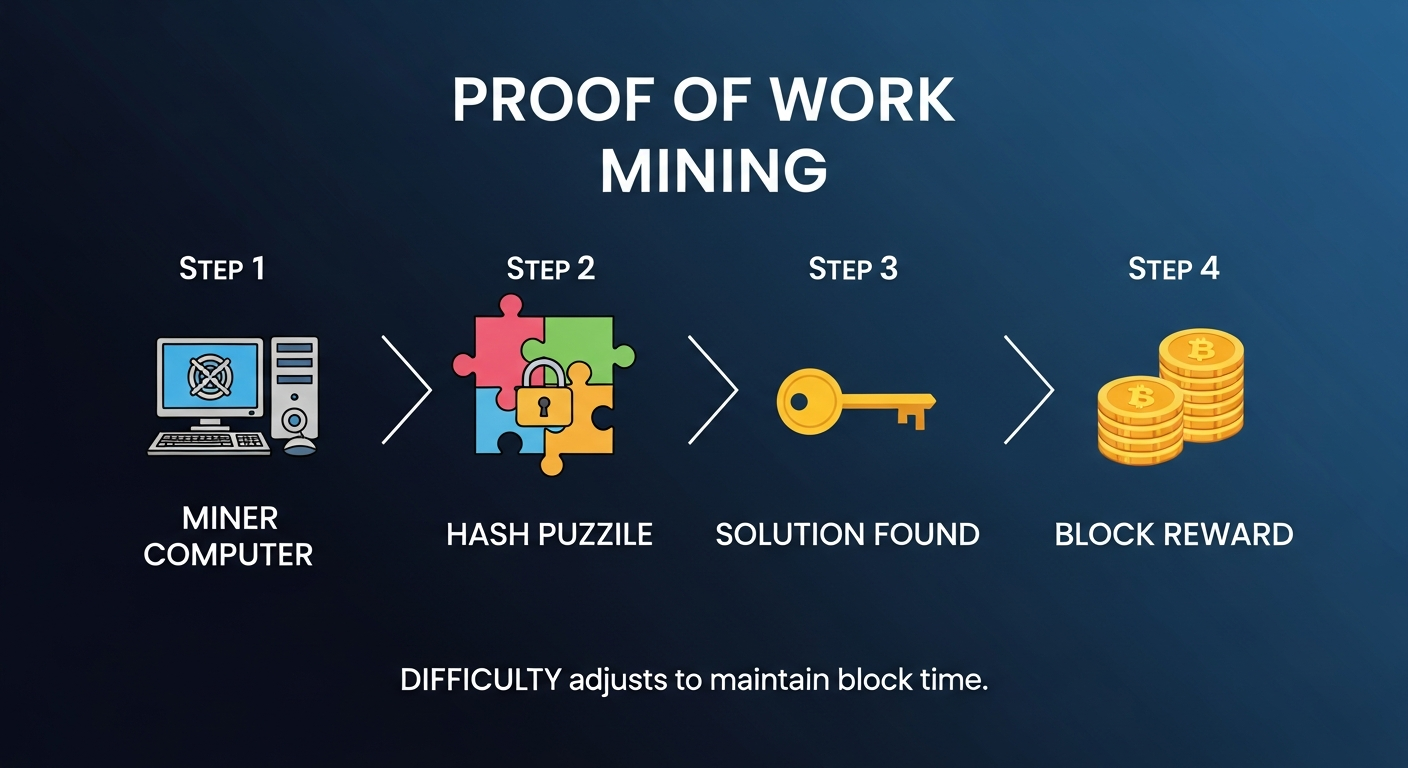
Figure: The mining process — miners compete to find a valid hash through computational work
Why Does Proof of Work Matter?
Before Bitcoin, every digital payment system required a trusted third party — a bank, a payment processor, or a central server — to verify that money wasn't being spent twice. Proof of Work eliminated this requirement by replacing trust with mathematics.
PoW matters because it provides three critical guarantees:
- Sybil Resistance: An attacker cannot simply create millions of fake identities to take over the network. Each "vote" on the valid chain requires real computational work and real electricity.
- Immutability: Altering any historical block requires re-doing all the computational work for that block and every subsequent block. As the chain grows, this becomes exponentially more expensive.
- Fair Distribution: New coins are distributed to those who contribute security to the network, creating an economic incentive to be honest rather than malicious.
💡 The Fundamental Trade-off
Proof of Work converts electricity and hardware into trust. The network is secure precisely because attacking it would cost more than any potential gain. This is sometimes called "thermodynamic security" — the laws of physics guarantee that reversing the blockchain requires an enormous expenditure of real-world energy.
Key Vocabulary
The Double-Spending Problem
The double-spending problem is the fundamental challenge that all digital currencies must solve. Unlike physical cash, which can only be in one place at a time, digital information can be copied endlessly. Without a solution, nothing stops someone from sending the same digital coin to two different people simultaneously.
How Traditional Systems Solve It
Banks solve double-spending through centralization. When you swipe your debit card, your bank checks a central database, verifies your balance, deducts the amount, and records the transaction. This works, but it requires you to trust the bank completely. The bank can freeze your account, reverse your transactions, deny service, or even become insolvent (as we saw with bank failures in 2008 and 2023).
How Proof of Work Solves It
Proof of Work solves double-spending without any central authority through a combination of mechanisms:
- Public Ledger: Every transaction is broadcast to the entire network. All nodes maintain a copy of every transaction ever made, so conflicting transactions are immediately visible.
- Block Ordering: Transactions are grouped into blocks that form an ordered chain. Once a transaction is included in a block and that block is mined (with computational work), it becomes part of the canonical history.
- Computational Cost: To change a confirmed transaction, an attacker would need to re-mine that block AND all subsequent blocks, which requires more computational power than the rest of the network combined.
- Longest Chain Rule: When two conflicting chains exist, the network follows the one with the most accumulated work. Honest miners always build on the longest chain, making it grow faster than any attacker's chain.
Imagine Alice has 1 BTC. She sends it to Bob for a laptop and simultaneously sends the same 1 BTC to herself at a different address. Both transactions are broadcast to the network. Miners see both and know they conflict. They include only one in the next block. The transaction in the mined block becomes valid; the other is discarded. After 6 confirmations (~60 minutes in Bitcoin), the transaction is considered irreversible because re-mining 6 blocks would require more energy than a small country consumes.
Confirmation Depth and Finality
The security of a transaction increases with each new block mined on top of it. This is called "confirmation depth":
| Confirmations | Security Level | Typical Use Case |
|---|---|---|
| 0 (unconfirmed) | Very Low | Not recommended for anything of value |
| 1 | Low-Medium | Small purchases (coffee, digital goods) |
| 3 | Medium | Moderate purchases (electronics, services) |
| 6 | High (Bitcoin standard) | Large transactions, exchange deposits |
| 60+ | Extremely High | Very large sums, institutional transactions |
The Mining Process Step by Step
Mining is often described as "solving complex math puzzles," but that's an oversimplification. Let's break down exactly what happens when a miner attempts to create a new block.
-
Step 1: Gather Transactions from the Mempool
The mempool (memory pool) is a waiting area where unconfirmed transactions sit after being broadcast to the network. Miners select transactions from the mempool, typically prioritizing those with higher fees. A miner might select anywhere from a few dozen to several thousand transactions for a single block.
-
Step 2: Create the Coinbase Transaction
The very first transaction in every block is the "coinbase transaction." This is a special transaction that creates new coins out of thin air and sends them to the miner's address. It represents the block reward plus all transaction fees from included transactions. This is how new currency enters circulation.
-
Step 3: Build the Merkle Tree
All selected transactions (including the coinbase) are organized into a Merkle tree — a binary tree of hashes. Each pair of transaction hashes is combined and hashed again, working upward until a single hash remains: the Merkle root. This root provides a compact summary of all transactions. If any transaction changes, the Merkle root changes completely.
-
Step 4: Construct the Block Header
The block header is an 80-byte data structure containing six fields: version number, previous block hash, Merkle root, timestamp, difficulty target (nBits), and nonce. This compact header is what gets hashed repeatedly during mining.
-
Step 5: Hash and Find the Golden Nonce
The miner runs SHA-256 twice (double-SHA-256) on the block header. If the resulting hash is below the current difficulty target, the block is valid. If not, the miner increments the nonce by 1 and tries again. This process repeats billions or trillions of times until a valid hash is found.
-
Step 6: Broadcast the Block
When a valid hash is found, the miner immediately broadcasts the complete block (header + all transactions) to the network. Other nodes verify the block independently: they check the hash is valid, all transactions are legitimate, the Merkle root matches, and the previous block hash is correct. Once verified, they add it to their copy of the chain and start mining the next block.
Block Structure Anatomy
Hash Puzzles, Nonces & Block Structure
At the heart of Proof of Work is the hash puzzle: finding an input that produces a hash output meeting specific criteria. Let's understand this in depth.
Properties of SHA-256
Bitcoin and Kenostod use the SHA-256 hash function, which has several critical properties that make mining possible:
- Deterministic: The same input always produces the exact same 256-bit (64 hex character) output.
- Avalanche Effect: Changing even a single bit of input completely changes the output. There's no way to predict how the hash will change.
- One-Way: Given a hash output, there's no way to reverse-engineer the input. The only approach is brute force.
- Collision Resistant: It's computationally infeasible to find two different inputs that produce the same hash.
- Fixed Output Size: Whether you hash "hello" or the entire Library of Congress, the output is always exactly 256 bits.
The Hash Puzzle Explained
What is the Nonce?
The nonce (Number Used Once) is a 32-bit integer field in the block header that miners modify with each attempt. It starts at 0 and is incremented by 1 each time. Since a 32-bit nonce only provides ~4.3 billion possibilities, modern miners also modify the coinbase transaction (extra nonce) and timestamp to create additional variation when the nonce range is exhausted.
Understanding the Target
The "difficulty target" is a 256-bit number. A valid block hash must be numerically less than this target. When people say "the hash must start with N leading zeros," that's a simplified way of expressing this numerical comparison. A lower target means more leading zeros are required, which means more hashes must be attempted, which means more work.
💡 Probability and Mining
Mining is fundamentally a game of probability. Each hash attempt has the same tiny chance of being valid. If the difficulty requires a hash starting with 19 leading zeros (as in Bitcoin today), the probability of any single hash being valid is approximately 1 in 276. That's roughly 1 in 75 sextillion. The entire Bitcoin network performs about 500 exahashes per second (500 × 1018 hashes/second) to find one valid block every 10 minutes.
Difficulty Adjustment
The difficulty adjustment algorithm is one of the most elegant aspects of Proof of Work. It ensures that blocks are produced at a consistent rate regardless of how much (or how little) mining power is on the network.
How Bitcoin's Difficulty Adjusts
Bitcoin recalculates its difficulty every 2,016 blocks (approximately every 2 weeks). The algorithm is straightforward:
Why This Matters
Without difficulty adjustment, the block time would become unpredictable. In the early days when few miners existed, blocks would be easy to find. As millions of miners joined, blocks would be found in milliseconds, causing chain splits, network congestion, and inflation spiraling out of control. The difficulty adjustment keeps the system stable through all conditions.
Historical Difficulty Growth
| Year | Bitcoin Difficulty | Network Hashrate | Context |
|---|---|---|---|
| 2009 | 1 | ~8 MH/s | Satoshi mining alone on a CPU |
| 2011 | ~1,000,000 | ~10 TH/s | GPU mining era begins |
| 2013 | ~500,000,000 | ~10 PH/s | First ASIC miners deployed |
| 2017 | ~1,500,000,000,000 | ~15 EH/s | Industrial mining farms |
| 2021 | ~25,000,000,000,000 | ~180 EH/s | China mining ban, hashrate migration |
| 2024 | ~75,000,000,000,000 | ~550 EH/s | Post-halving, publicly traded miners |
✅ Self-Regulating Network
Bitcoin's difficulty has increased by a factor of 75 trillion since its creation, yet blocks still arrive approximately every 10 minutes. This remarkable consistency across 15+ years is a testament to the elegance of the difficulty adjustment algorithm. Whether the network hashrate doubles or is cut in half (as happened during China's 2021 mining ban), the system self-corrects within 2 weeks.
Nakamoto Consensus & the Longest Chain Rule
Nakamoto Consensus is the name given to Bitcoin's consensus protocol as described in Satoshi Nakamoto's 2008 whitepaper. It combines Proof of Work with the longest chain rule (more precisely, the "heaviest chain" or "most cumulative work" rule) to allow a decentralized network to agree on a single version of truth.
How It Works
In a decentralized network, there's no central server to say "this is the correct order of transactions." Instead, Nakamoto Consensus uses the following principles:
- Anyone can propose blocks: Any miner can attempt to create the next block. There's no permission required.
- Valid blocks require Proof of Work: You can only propose a block if you've found a valid hash below the difficulty target. This prevents spam and Sybil attacks.
- The chain with the most cumulative work wins: If two miners find valid blocks at nearly the same time, a temporary fork occurs. The network resolves this by following whichever branch accumulates more Proof of Work (more blocks) first. The other branch becomes "orphaned."
- Nodes independently verify everything: No node trusts any other node. Each node verifies every block and every transaction independently against the consensus rules.
Fork Resolution Example
Unlike some newer consensus mechanisms that provide deterministic finality (a transaction is final, period), Nakamoto Consensus provides probabilistic finality. A transaction becomes exponentially harder to reverse with each confirmation. After 6 confirmations in Bitcoin, the probability of reversal is approximately 0.000000001% for an attacker with 10% of network hashrate. This is good enough for practical purposes, though mathematically it never reaches absolute zero.
Mining Hardware Evolution: CPU to ASIC
The history of mining hardware is a fascinating story of technological escalation. As Bitcoin's value increased, the economic incentive to mine more efficiently drove a hardware arms race that has reshaped the entire computing industry.
The Four Eras of Mining
Era 1: CPU Mining (2009–2010)
In Bitcoin's earliest days, Satoshi Nakamoto mined with a standard desktop CPU. The difficulty was 1, and a single CPU could find blocks. Satoshi is estimated to have mined approximately 1 million BTC during this period. The hashrate of a typical CPU was about 2–20 MH/s (megahashes per second).
Era 2: GPU Mining (2010–2013)
In October 2010, the first GPU mining code was released. Graphics cards are designed for parallel processing (rendering millions of pixels simultaneously), which maps perfectly to the SHA-256 hashing required for mining. A single high-end GPU could achieve 200–800 MH/s, making CPUs obsolete overnight. GPU mining rigs with 6–8 cards became common.
Era 3: FPGA Mining (2011–2013)
Field-Programmable Gate Arrays (FPGAs) offered better energy efficiency than GPUs while being reprogrammable. They achieved similar hashrates to GPUs but used significantly less electricity. However, they were expensive and difficult to program, making them a transitional technology.
Era 4: ASIC Mining (2013–Present)
Application-Specific Integrated Circuits (ASICs) are chips designed exclusively for SHA-256 hashing. They cannot do anything else, but they do mining extraordinarily well. The first Bitcoin ASIC (Avalon) shipped in January 2013. Modern ASICs like the Bitmain Antminer S21 achieve 200 TH/s (terahashes per second) — that's 10 million times faster than the best GPU.
Hardware Comparison
| Hardware | Hashrate | Power Draw | Efficiency | Cost |
|---|---|---|---|---|
| CPU (Core i7) | ~20 MH/s | ~100W | 0.2 MH/J | $300 |
| GPU (RTX 3090) | ~120 MH/s | ~300W | 0.4 MH/J | $1,500 |
| FPGA | ~800 MH/s | ~40W | 20 MH/J | $2,000 |
| ASIC (S19 Pro) | 110 TH/s | 3,250W | 33.8 J/TH | $3,000 |
| ASIC (S21) | 200 TH/s | 3,550W | 17.5 J/TH | $5,000 |
ASICs have made Bitcoin mining inaccessible to ordinary individuals. Only companies that can invest millions in hardware, secure cheap electricity, and build data-center-scale cooling systems can compete. This has led to concerns about mining centralization, as a handful of large mining companies now produce the majority of blocks. Some cryptocurrencies (like Monero with RandomX and Ethereum's former Ethash) have deliberately chosen "ASIC-resistant" algorithms to keep mining accessible to GPU owners.
Mining Pools
A mining pool is a group of miners who combine their computational resources and share the block rewards proportionally. Pools exist because solo mining has become impractical for individual miners due to the enormous difficulty of finding a block.
Why Pools Exist
Consider this: with a single Antminer S21 (200 TH/s), the expected time to solo-mine a Bitcoin block at current difficulty is approximately 25 years. You would need to run the machine continuously for decades before statistically expecting to find a single block. Mining pools solve this "variance problem" by letting thousands of miners work together and share rewards proportionally.
How Pools Work
- Pool assigns work: The pool operator distributes work units to participating miners. Each miner gets a portion of the nonce space to search.
- Miners submit "shares": Miners send back valid hashes that meet a lower difficulty threshold (easier than the real target). These "shares" prove the miner is doing real work.
- Pool finds block: When one miner's hash happens to meet the actual network difficulty, the pool submits the block to the network.
- Rewards distributed: The block reward is split among all miners based on how many valid shares they submitted during that round.
Pool Reward Distribution Methods
| Method | Description | Risk to Miner |
|---|---|---|
| PPS (Pay Per Share) | Fixed payout per valid share, regardless of whether the pool finds a block | Low (pool absorbs variance) |
| PPLNS (Pay Per Last N Shares) | Payout based on shares submitted in a window before a block is found | Medium (rewards vary) |
| FPPS (Full PPS) | Like PPS but also includes estimated transaction fees | Low |
| Proportional | When a block is found, reward split by proportion of shares in that round | Higher (long rounds = less pay) |
Major Mining Pools (Bitcoin)
As of 2024, the largest Bitcoin mining pools include Foundry USA (~30% of hashrate), AntPool (~20%), F2Pool (~12%), ViaBTC (~11%), and Binance Pool (~10%). The top 5 pools collectively control over 80% of the network hashrate, which raises centralization concerns.
💡 Pool Centralization vs. Network Centralization
While pool concentration looks concerning, individual miners can switch pools at any time. If a pool attempted to act maliciously (e.g., censoring transactions), miners would leave and join honest pools. The real concern is the concentration of ASIC manufacturing (dominated by Bitmain and MicroBT) and geographic concentration of mining (heavily concentrated in the US, Kazakhstan, and Russia after China's ban).
Mining Economics & Block Reward Halving
Mining is ultimately a business. Miners invest in hardware and electricity to earn block rewards and transaction fees. Understanding the economics of mining reveals how the entire system's incentive structure works.
Revenue Components
A miner's revenue comes from two sources:
- Block Subsidy: Newly minted coins created with each block. This is the primary revenue source today.
- Transaction Fees: Fees attached to each transaction included in the block. As the block subsidy decreases over time, transaction fees are expected to become the dominant revenue source.
The Halving Schedule
Bitcoin's most important monetary policy feature is the halving: every 210,000 blocks (approximately every 4 years), the block subsidy is cut in half. This creates a predictable, decreasing supply schedule that eventually caps Bitcoin's total supply at 21 million coins.
| Halving # | Year | Block Subsidy | Total BTC Mined | % of Supply |
|---|---|---|---|---|
| 0 (Launch) | 2009 | 50 BTC | 0 | 0% |
| 1st | 2012 | 25 BTC | 10.5M | 50% |
| 2nd | 2016 | 12.5 BTC | 15.75M | 75% |
| 3rd | 2020 | 6.25 BTC | 18.375M | 87.5% |
| 4th | 2024 | 3.125 BTC | 19.6875M | 93.75% |
| Last | ~2140 | 0 BTC | 21M | 100% |
Profitability Calculation
A miner's profitability depends on several variables. Here's a simplified calculation:
Electricity cost is the single biggest variable in mining profitability. At $0.03/kWh (common in places like Texas, Paraguay, or Kazakhstan), mining is highly profitable. At $0.15/kWh (typical US residential rate), most miners operate at a loss. This is why large mining operations locate near cheap, abundant energy sources — hydroelectric dams, natural gas flares, geothermal plants, or nuclear power stations.
Energy Consumption & Environmental Debate
The energy consumption of Proof of Work mining is one of the most debated topics in cryptocurrency. Understanding both sides of this argument is essential for an informed perspective.
The Scale of Energy Use
The Bitcoin network consumes an estimated 120–150 TWh per year (as of 2024), which is comparable to the electricity consumption of countries like Argentina or Norway. This powers the approximately 550 EH/s of global hashrate, with millions of ASIC machines running 24/7 in data centers around the world.
Arguments Against PoW Energy Use
- Carbon Footprint: When mining is powered by fossil fuels (coal, natural gas), it contributes to carbon emissions. After China's mining ban, much hashrate moved to Kazakhstan, which relies heavily on coal power.
- E-Waste: ASIC miners become obsolete in 3–5 years as more efficient models are released. The old machines cannot be repurposed for anything else, creating electronic waste.
- Proportionality: Critics argue that using more electricity than some countries to process ~7 transactions per second (Bitcoin's base layer) is inherently wasteful.
Arguments in Favor of PoW Energy Use
- Renewable Energy Incentive: Miners seek the cheapest electricity, which is increasingly renewable. The Bitcoin Mining Council reports that approximately 60% of Bitcoin mining uses sustainable energy sources. Mining can make renewable energy projects economically viable by acting as a "buyer of last resort" for excess energy.
- Stranded Energy Utilization: Mining can capture energy that would otherwise be wasted — flared natural gas, curtailed wind/solar, or remote hydroelectric power with no transmission lines to population centers.
- Grid Stabilization: Miners can quickly power down during peak demand periods, acting as a flexible load that helps stabilize electrical grids. In Texas, miners earned payments for reducing consumption during heat waves.
- Security Cost: The energy spent on mining is the cost of securing a $1+ trillion network without any central authority. Compared to the energy consumed by the traditional banking system (office buildings, data centers, ATMs, armored trucks, server farms), the comparison becomes more nuanced.
The energy debate is not black and white. The real question isn't "does Bitcoin use a lot of energy?" (it does) but rather "is the energy use justified by the value provided?" and "what energy sources are being used?" A Bitcoin miner powered by otherwise-wasted methane from a Texas oil well has a very different environmental impact than one powered by a coal plant in Mongolia. The industry is trending toward renewables, but significant challenges remain.
PoW vs PoS & Other Consensus Mechanisms
Proof of Work is not the only way to achieve consensus. Several alternative mechanisms have been developed, each with different tradeoffs. The most prominent alternative is Proof of Stake (PoS), which Ethereum famously switched to in September 2022.
Comprehensive Comparison
| Feature | Proof of Work | Proof of Stake |
|---|---|---|
| Security Source | Computational work (energy) | Staked capital (coins locked up) |
| Block Producers | Miners (hardware + electricity) | Validators (staked coins) |
| Energy Use | Very high (100+ TWh/year for Bitcoin) | Very low (~0.01 TWh/year for Ethereum) |
| Entry Barrier | Expensive hardware, cheap electricity | Capital to stake (32 ETH for Ethereum) |
| Attack Cost | 51% of hashrate (hardware + electricity) | 33–51% of staked coins + risk of slashing |
| Decentralization | ASIC manufacturing concentrated | Large stakers have more influence |
| Finality | Probabilistic (grows with confirmations) | Can be deterministic (epoch finality) |
| Track Record | 15+ years, never successfully attacked | Newer, less battle-tested at Bitcoin's scale |
| Wealth Concentration Risk | Anyone can mine (if they have hardware) | "Rich get richer" (more stake = more rewards) |
Other Consensus Mechanisms
💡 Why Bitcoin Remains PoW
Despite the energy criticism, Bitcoin's community has no plans to switch to Proof of Stake. The arguments: (1) PoW has a 15-year track record with zero successful attacks on Bitcoin, (2) PoW provides objective, thermodynamic security that doesn't depend on the value of the coin itself, (3) changing Bitcoin's consensus mechanism would be an unprecedented and extremely risky hard fork, and (4) PoW's energy expenditure creates a real-world "anchor" that makes the blockchain physically expensive to attack.
The 51% Attack & Network Security
A 51% attack (also called a majority attack) occurs when a single entity controls more than half of the network's mining hashrate. With majority hashrate, the attacker can potentially rewrite recent blockchain history and double-spend coins.
What a 51% Attacker Can Do
- Double-spend their own coins: Send coins to an exchange, sell them for fiat, then rewrite the chain to reverse the original transaction. The attacker gets both the fiat and their coins back.
- Censor transactions: Refuse to include certain transactions in blocks they mine, effectively preventing specific addresses from using the network.
- Prevent other miners' blocks: Build a private chain faster than the public chain, then release it to orphan honest miners' blocks.
What a 51% Attacker CANNOT Do
- Steal coins from other addresses: They still cannot forge digital signatures or spend coins they don't own.
- Create coins out of thin air: Invalid blocks (with excessive rewards) would still be rejected by all honest nodes.
- Change consensus rules: Other nodes independently verify all rules and would reject invalid blocks regardless of hashrate.
Cost of Attacking Bitcoin
Attacking Bitcoin's network is astronomically expensive. As of 2024, a 51% attack on Bitcoin would require:
- Acquiring approximately 275 EH/s of hashrate
- This means roughly 1.4 million Antminer S21 machines ($7 billion in hardware alone)
- Electricity costs of approximately $20 million per day to operate
- Data center infrastructure, cooling, and networking costs
- Even if successful, the attack would crash Bitcoin's price, making any stolen coins worth far less
While Bitcoin has never been successfully 51%-attacked, smaller PoW chains have been. Ethereum Classic (ETC) suffered multiple 51% attacks in 2020, with attackers double-spending millions of dollars. Bitcoin Gold (BTG) was attacked in 2018 and 2020. Verge (XVG) was attacked multiple times. These attacks demonstrate that PoW security is directly proportional to the total hashrate securing the network — which is why Bitcoin's massive hashrate is its greatest security feature.
Defense Mechanisms
- High hashrate: The more computational power securing the network, the more expensive an attack becomes.
- Confirmation requirements: Exchanges and merchants requiring more confirmations makes attacks less profitable (the attacker must maintain majority hashrate for longer).
- Economic incentives: A successful attack would crash the coin's price, destroying the value of the attacker's own holdings and mining hardware.
- Community response: The community could respond to an attack by changing the mining algorithm (a "nuclear option" that would make the attacker's ASICs worthless).
Kenostod's Proof-of-Work Implementation
Kenostod implements its own Proof-of-Work system designed for educational purposes while maintaining the core principles of real blockchain mining. Understanding Kenostod's PoW helps bridge the gap between theory and practice.
Kenostod Mining Parameters
| Parameter | Kenostod | Bitcoin (for comparison) |
|---|---|---|
| Hash Algorithm | SHA-256 | Double SHA-256 |
| Target Block Time | ~1 minute | ~10 minutes |
| Initial Block Reward | 100 KENO | 50 BTC |
| Halving Interval | Every 210,000 blocks | Every 210,000 blocks |
| Difficulty Adjustment | Every 100 blocks | Every 2,016 blocks |
| Difficulty Direction | Up if too fast, down if too slow | Same principle |
Mining in the Kenostod Simulator
When you mine in Kenostod, the simulator faithfully replicates the real mining process:
- Pending transactions are collected from the mempool
- A block header is constructed with the previous block hash, Merkle root, timestamp, and nonce
- The SHA-256 hash function runs repeatedly with incrementing nonces
- You can watch the hash attempts in real-time and see the nonce counting up
- When a valid hash is found (below the difficulty target), the block is added to the chain
- Your mining reward (100 KENO + transaction fees) is credited to your wallet
✅ Kenostod's Educational Advantage
Unlike real Bitcoin mining (which requires expensive ASICs), Kenostod's difficulty is calibrated for browser-based mining. You can actually watch the mining process happen in real-time, see each nonce attempt, and understand viscerally what "computational work" means. This hands-on experience makes the theoretical concepts tangible.
Real-World Case Studies
These real events demonstrate the practical implications of Proof of Work mining in the real world:
Case Study 1: The Bitcoin Genesis Block (January 3, 2009)
What happened: Satoshi Nakamoto mined the first-ever Bitcoin block (Block #0, the "Genesis Block") on a standard desktop computer. Embedded in the coinbase transaction was the text: "The Times 03/Jan/2009 Chancellor on brink of second bailout for banks" — a reference to a London Times headline about the 2008 financial crisis.
The significance: This timestamp proves the block couldn't have been pre-mined before January 3, 2009, and the message itself captures the philosophical motivation behind Bitcoin: creating money that doesn't depend on governments or banks that might fail.
The lesson: Proof of Work mining started with a single CPU and a single person. The system was designed to scale from one miner to millions while maintaining security through the difficulty adjustment mechanism.
Case Study 2: China's Mining Ban (May–June 2021)
What happened: China, which hosted approximately 65% of global Bitcoin hashrate, banned all cryptocurrency mining. Within weeks, miners began shutting down or physically relocating equipment to other countries (USA, Kazakhstan, Russia, Canada).
The impact: Bitcoin's hashrate dropped by 50% almost overnight. But the difficulty adjustment kicked in, reducing difficulty by approximately 28% over the next adjustment period. Block times temporarily increased to ~15–20 minutes but returned to normal within weeks. The network never went down, never lost data, and continued processing transactions throughout the entire migration.
The lesson: This was the most dramatic real-world test of Bitcoin's resilience. The difficulty adjustment mechanism proved that even losing the majority of mining power cannot kill a well-designed PoW network. It also demonstrated the geographic decentralization benefit: no single country can shut down a global PoW network.
Case Study 3: Ethereum Classic 51% Attacks (2020)
What happened: Ethereum Classic (ETC) suffered three separate 51% attacks in August 2020. Attackers rented hashrate from services like NiceHash, gained majority control of the ETC network, and reorganized thousands of blocks, double-spending over $7 million worth of ETC.
Why it worked: ETC has a much smaller hashrate than Ethereum or Bitcoin. The cost to rent enough hashrate for a 51% attack was estimated at only $5,000–$10,000 per hour, making the attack highly profitable.
The lesson: PoW security is directly proportional to the total hashrate securing the network. Small PoW chains are vulnerable because the cost to attack them is low relative to potential profit. This is why Bitcoin maximalists argue that only the largest PoW chain can be considered truly secure.
Case Study 4: Bitcoin Halving Market Cycles
What happened: Each of Bitcoin's four halvings (2012, 2016, 2020, 2024) has been followed by significant price appreciation within the subsequent 12–18 months. The 2012 halving preceded a rise from ~$12 to ~$1,100. The 2016 halving preceded a rise from ~$650 to ~$20,000. The 2020 halving preceded a rise from ~$8,600 to ~$69,000.
The mechanism: Halvings reduce the daily sell pressure from miners (who must sell coins to cover electricity costs). If demand remains constant but new supply drops by 50%, basic economics suggests the price should increase. However, this is debated, and past performance does not guarantee future results.
The lesson: The halving schedule is a fundamental aspect of PoW economics. It creates a predictable, decreasing inflation rate that makes Bitcoin increasingly scarce over time. Understanding halvings is essential for understanding cryptocurrency market cycles and mining profitability dynamics.
Written Exercises
Complete these exercises to reinforce your understanding. Take your time — thoughtful answers demonstrate true comprehension.
Exercise 1: Explain It Simply
A friend asks you: "Why does Bitcoin use so much electricity? Can't they just use a normal database?" Write a clear explanation of why Proof of Work requires energy expenditure and what would be lost if Bitcoin simply used a centralized database instead.
Exercise 2: Mining Profitability Analysis
You are considering purchasing an ASIC miner that produces 200 TH/s and consumes 3,500W. The machine costs $5,000. Your electricity rate is $0.08/kWh. The current Bitcoin price is $60,000 and the network hashrate is 500 EH/s. Calculate your estimated daily revenue, daily electricity cost, and how many days until you break even. Show your work.
Exercise 3: PoW vs PoS Debate
Ethereum switched from Proof of Work to Proof of Stake in September 2022 ("The Merge"), reducing its energy consumption by ~99.95%. Should Bitcoin do the same? Present arguments for BOTH sides, then state which position you find more convincing and why.
Exercise 4: 51% Attack Scenario
Imagine you are the security advisor for a cryptocurrency exchange. A small PoW coin (let's call it "SmallCoin") wants to be listed on your exchange. SmallCoin has a total network hashrate of only 10 TH/s and uses SHA-256. What concerns would you have? What listing requirements would you impose? How many confirmations would you require for deposits?
Exercise 5: The Double-Spending Scenario
Walk through, step by step, how a double-spending attack would work if someone had 51% of the network hashrate. Start from the attacker sending coins to a merchant, then explain how they would create an alternative chain. Why does waiting for more confirmations make this attack harder?
Hands-On Lab
Now it's time to put your knowledge into action! Complete ALL of the following tasks in the Kenostod blockchain simulator.
Lab Tasks:
-
Task 1: Start the Mining Simulator
Navigate to the Mining tab in the Kenostod platform. Observe the mining interface and familiarize yourself with the current difficulty, block height, and reward amount.
-
Task 2: Watch Hash Calculations
Start mining and watch the hash calculations happen in real-time. Pay attention to the nonce counter incrementing and the hash output changing completely with each attempt. This demonstrates the avalanche effect of SHA-256.
-
Task 3: Mine Your First Block
Successfully mine a block and observe the entire process: transaction gathering, block construction, nonce searching, and block validation. Note the block reward credited to your wallet.
-
Task 4: Verify in the Block Explorer
After mining, go to the Blockchain Explorer tab and find your newly mined block. Examine its structure: block hash, previous hash, timestamp, nonce, and included transactions.
-
Task 5: Mine Multiple Blocks
Mine 2–3 more blocks and observe how each block references the previous block's hash, forming the chain. Notice how the difficulty may adjust as you mine more blocks.
Opens in the main platform. Complete all 5 tasks, then return here for the Final Exam!
Final Exam (12 Questions)
You must score at least 10 out of 12 correct (80%) to complete this course and earn your 250 KENO reward. Take your time and review the material if needed.
Kenostod Blockchain Academy © 2024