Learning Objectives
By the end of this course, you will be able to:
- Explain what blockchain governance is and why it matters for decentralized networks
- Compare on-chain governance vs off-chain governance and their trade-offs
- Understand DAO structures, legal frameworks, and organizational models
- Evaluate voting mechanisms: token-weighted, quadratic, conviction, and rage-quit
- Navigate governance frameworks like Compound Governor, Aragon, and Snapshot
- Analyze real-world governance events: The DAO hack, Uniswap drama, MakerDAO
- Design treasury management and participation incentive strategies
- Understand progressive decentralization and KENO's governance roadmap
This course is designed for thorough learning. Plan for ~2 hours of reading, exercises, and practice. Governance is one of the most important — and most debated — topics in all of blockchain. Take your time with the case studies and exercises. The 250 KENO reward reflects that commitment.
What Is Blockchain Governance?
Blockchain governance refers to the processes, rules, and structures that determine how a decentralized network evolves over time. Every blockchain faces fundamental questions: Who decides which upgrades get implemented? How are resources allocated? What happens when the community disagrees?
In traditional companies, a CEO or board of directors makes these decisions. In nation-states, elected officials legislate on behalf of citizens. But blockchains are different — they aim to be decentralized, meaning no single entity should have unilateral control. This creates a fascinating challenge: how do you coordinate thousands (or millions) of stakeholders without a central authority?
Governance is arguably the hardest unsolved problem in cryptocurrency. Get it right, and you create a self-sustaining, evolving ecosystem. Get it wrong, and you end up with contentious forks, plutocracy, or complete gridlock.
The Three Pillars of Blockchain Governance
💡 Why Governance Matters
Bitcoin's block size debate raged for years and ultimately led to a hard fork creating Bitcoin Cash. Ethereum's response to The DAO hack in 2016 led to Ethereum Classic. These events demonstrate that governance failures can literally split a blockchain in two, destroying billions of dollars in value and fracturing communities.
Governance vs. Government
It's important to distinguish between governance and government. Governance is the broader concept of how decisions are made and enforced within a system. Government is a specific institution. Blockchain governance aims to provide the coordination benefits of government without the centralization risks. Think of it as rules without rulers.
Traditional governance relies on identity and enforcement — citizens are identified, votes are tied to individuals, and laws are enforced by courts and police. Blockchain governance often relies on cryptoeconomic mechanisms — stakes, tokens, and game theory — to align incentives without requiring identity or centralized enforcement.
On-Chain vs Off-Chain Governance
One of the most fundamental distinctions in blockchain governance is whether decisions are made and enforced on-chain (through smart contracts and protocol rules) or off-chain (through social consensus, forums, and informal coordination).
On-Chain Governance
In on-chain governance, proposals are submitted as transactions, votes are recorded on the blockchain, and approved changes are automatically implemented by the protocol. Everything is transparent, verifiable, and binding.
How it works: A token holder submits a proposal (often with a required stake). Other token holders vote during a defined voting period. If the proposal reaches the required threshold (quorum + majority), the change is automatically executed by the smart contract — no human intermediary needed.
- Pros: Transparent, immutable vote record; automatic execution; clear legitimacy; no ambiguity about whether a proposal passed
- Cons: Low voter turnout; plutocratic (whales dominate); smart contract bugs can have catastrophic effects; difficult to make nuanced decisions
- Examples: Tezos, Polkadot, Compound, MakerDAO
Off-Chain Governance
Off-chain governance relies on social consensus built through forums, developer meetings, social media, and informal discussions. Changes are implemented by developers who follow community sentiment.
How it works: Anyone can propose changes through discussion forums (BIPs for Bitcoin, EIPs for Ethereum). Community members debate the merits. Core developers assess technical feasibility. If rough consensus emerges, developers implement the change. Node operators choose whether to adopt it.
- Pros: More nuanced discussion; less susceptible to plutocracy; allows for complex technical debate; lower barrier to participation
- Cons: Opaque decision-making; core developer capture risk; "rough consensus" is subjective; slow and contentious
- Examples: Bitcoin (BIPs), Ethereum (EIPs), Linux kernel development
Hybrid Governance
Most modern protocols use a hybrid approach — combining on-chain voting for clear, quantifiable decisions (parameter changes, treasury allocations) with off-chain discussion for complex, nuanced topics (protocol upgrades, vision setting).
| Feature | On-Chain | Off-Chain | Hybrid |
|---|---|---|---|
| Transparency | Fully transparent | Varies widely | Mixed |
| Execution | Automatic via smart contract | Manual by developers | Automatic for some decisions |
| Speed | Fixed voting periods | Can take months/years | Depends on decision type |
| Participation | Requires token ownership | Open to anyone | Tiered access |
| Plutocracy Risk | High | Lower | Moderate |
| Complexity Handling | Simple binary decisions | Nuanced discussions | Both types supported |
Snapshot is a popular off-chain voting tool that uses on-chain data. It lets token holders vote using their blockchain balances without paying gas fees. Votes are stored on IPFS (a decentralized file system), making them verifiable but not enforceable on-chain. Many DAOs use Snapshot for "temperature checks" before committing to on-chain votes, combining accessibility with accountability.
DAO Structures & Legal Frameworks
A Decentralized Autonomous Organization (DAO) is an organization where rules are encoded in smart contracts and decisions are made collectively by members, typically token holders. DAOs represent a radical experiment in human coordination — organizations without traditional management hierarchies.
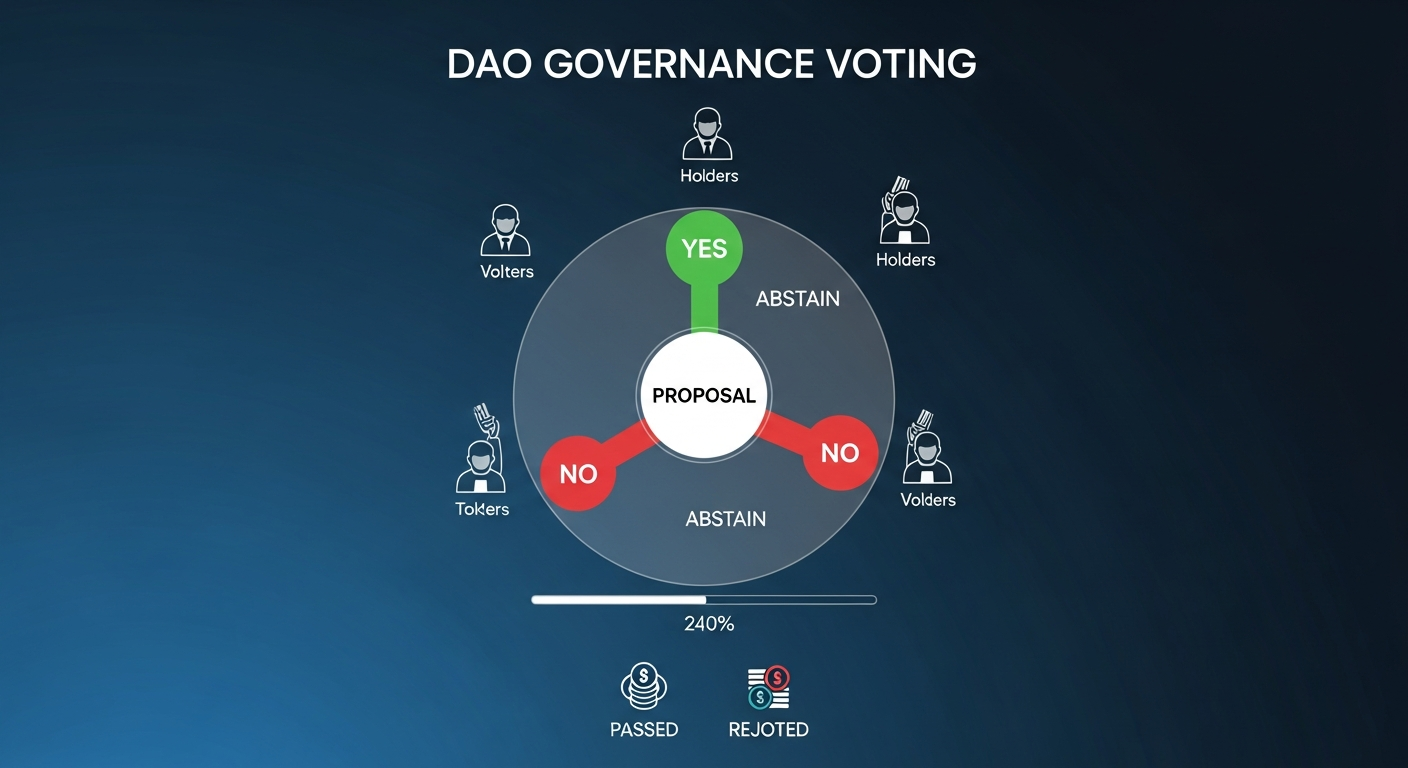
Figure: How proposals flow through the DAO governance process
Types of DAOs
Protocol DAOs
Govern DeFi protocols and blockchain infrastructure. Members vote on protocol parameters, upgrades, and treasury allocations. Examples: MakerDAO (governs the DAI stablecoin), Uniswap (governs the DEX), Aave (governs the lending protocol).
Investment DAOs
Pool capital from members and collectively decide on investments. Members vote on which projects, tokens, or assets to invest in. Examples: The LAO, MetaCartel Ventures, BitDAO.
Social DAOs
Built around communities, culture, and shared interests. Membership is often gated by token ownership. Examples: Friends With Benefits (FWB), PleasrDAO (NFT collecting), Developer DAO.
Service DAOs
Coordinate freelancers and service providers in a decentralized manner. Members contribute work and receive compensation from the DAO treasury. Examples: Raid Guild (web3 development), LexDAO (legal services).
Legal Frameworks for DAOs
One of the biggest challenges facing DAOs is their legal status. Traditional legal systems don't easily accommodate organizations without registered officers, physical addresses, or clear jurisdictions. Several approaches have emerged:
| Legal Structure | Jurisdiction | Key Features |
|---|---|---|
| DAO LLC | Wyoming, USA | Limited liability for members; smart contract recognized as operating agreement; first U.S. state to recognize DAOs |
| Foundation | Cayman Islands, Switzerland | No shareholders; council governs on behalf of DAO; used by Ethereum Foundation, Solana Foundation |
| Unincorporated Association | Various (UK, US) | No formal registration; members may face unlimited personal liability; risky but fully decentralized |
| DAO-Specific Legislation | Marshall Islands, Vermont | Purpose-built legal frameworks; emerging but not yet tested in courts |
Without a legal wrapper, DAO members may be treated as a general partnership under many jurisdictions. This means every member could be personally liable for the DAO's debts and legal obligations. This is why many DAOs are now incorporating as LLCs, foundations, or other legal entities.
Voting Mechanisms Deep Dive
Not all voting systems are created equal. The choice of voting mechanism fundamentally shapes who has power, how decisions are made, and what outcomes are possible. Let's explore the major approaches.
Token-Weighted Voting (1 Token = 1 Vote)
The simplest and most common mechanism. Your voting power is directly proportional to the number of governance tokens you hold.
Example: Proposal to Reduce Transaction Fees by 50%
✅ Proposal PASSED (60% threshold met)
- Pros: Simple to understand; easy to implement; aligns with financial stake
- Cons: Plutocratic — whales (large holders) dominate; encourages token accumulation for governance control; doesn't represent community breadth
Quadratic Voting
Quadratic voting reduces the influence of large holders by making each additional vote increasingly expensive. The cost of N votes is N² tokens. This means 1 vote costs 1 token, but 10 votes cost 100 tokens, and 100 votes cost 10,000 tokens.
- Pros: More democratic; reduces whale dominance; encourages broad participation
- Cons: Vulnerable to Sybil attacks (one person creating many wallets); requires identity verification to be truly effective
- Used by: Gitcoin Grants, some Optimism governance proposals
Conviction Voting
Conviction voting is a continuous, time-based system where your voting power on a proposal increases the longer you stake your tokens on it. Instead of discrete voting periods, conviction accumulates over time like compound interest.
- How it works: You stake tokens on a proposal. Over time, your "conviction" builds. Once enough collective conviction is reached, the proposal passes automatically.
- Pros: No rigid voting deadlines; rewards long-term commitment; less susceptible to last-minute manipulation; supports continuous proposal evaluation
- Cons: More complex to understand; harder to predict outcomes; favors patient participants over urgent needs
- Used by: 1Hive, Gardens (Commons Stack), some Aragon implementations
Delegated Voting (Liquid Democracy)
Token holders can delegate their voting power to trusted representatives (delegates) who vote on their behalf. Unlike traditional representative democracy, you can change your delegate at any time and can vote directly on any proposal, overriding your delegate.
- How it works: You choose a delegate who shares your values. They vote on proposals for you. You can override their vote or switch delegates anytime.
- Pros: Reduces voter fatigue; enables informed decision-making through specialized delegates; maintains voter sovereignty
- Cons: Can lead to delegate power concentration; delegates may not always represent your views; creates a pseudo-representative system
- Used by: Compound, Uniswap, Optimism, ENS
Rage-Quit Mechanism
The "rage-quit" mechanism allows dissenting members to withdraw their proportional share of the treasury before a proposal they disagree with is executed. This provides a crucial safety valve against majority tyranny.
- Used by: MolochDAO and its forks (DAOhaus)
- Key benefit: No one is forced to participate in a decision they fundamentally disagree with
| Mechanism | Whale Resistance | Sybil Resistance | Complexity | Participation |
|---|---|---|---|---|
| Token-Weighted | ❌ Low | ✅ High | ✅ Simple | ❌ Low |
| Quadratic | ✅ High | ❌ Low | 🔶 Medium | ✅ High |
| Conviction | 🔶 Medium | 🔶 Medium | ❌ Complex | 🔶 Medium |
| Delegated | 🔶 Medium | ✅ High | 🔶 Medium | ✅ High |
Governance Frameworks & Tools
Building governance from scratch is extremely complex. Fortunately, several battle-tested frameworks have emerged that protocols can adopt or adapt.
Compound Governor (Governor Bravo / Governor Alpha)
Developed by Compound Finance, this is the most widely forked governance framework in DeFi. It defines a complete on-chain governance lifecycle.
- Used by: Compound, Uniswap, Aave, Gitcoin, and 100+ protocols
- Strengths: Battle-tested; extensive tooling; OpenZeppelin provides audited implementations
- Weaknesses: High proposal thresholds exclude small holders; simple majority can be gamed
Aragon
Aragon provides a modular framework for creating and managing DAOs. It offers a suite of tools including voting, finance management, permissions, and agent contracts. Aragon DAOs are fully customizable through a plugin system.
- Key Features: DAO creation in minutes; modular plugin architecture; built-in treasury management; permission management system
- Used by: Lido, API3, Decentraland, and thousands of smaller DAOs
- Strengths: User-friendly; highly customizable; good for non-technical teams
Snapshot
Snapshot is an off-chain, gasless voting platform. Votes are signed messages stored on IPFS, using on-chain token balances as voting power. This makes voting free for participants while maintaining verifiability.
- Key Features: Zero gas fees for voting; customizable voting strategies; multi-chain support; integration with ENS
- Used by: 30,000+ spaces including Aave, Sushi, Yearn, Balancer, ENS
- Limitations: Votes are not binding on-chain; requires trust that results will be respected; no automatic execution
Tally
Tally provides a governance dashboard and interface for Governor-based DAOs. It makes on-chain governance accessible with user-friendly proposal creation, voting, and delegation interfaces.
| Framework | Type | Gas Cost | Binding | Best For |
|---|---|---|---|---|
| Compound Governor | On-chain | High | Yes (auto-execute) | Large DeFi protocols |
| Aragon | On-chain | Medium | Yes | New DAOs, non-technical teams |
| Snapshot | Off-chain | Free | No (social contract) | Temperature checks, broad participation |
| Tally | Interface | Varies | Yes (via Governor) | Governor DAO frontends |
Proposals & Governance Lifecycle
Every governance decision follows a lifecycle from initial idea to implementation. Understanding this process is essential for effective participation.
The Proposal Lifecycle
-
Ideation & Discussion
Ideas are first discussed informally on forums (Discourse, Commonwealth), Discord, or Twitter. This "temperature check" phase helps refine proposals before formal submission. Many DAOs require a forum post and community discussion before a formal proposal can be created.
-
Formal Proposal Submission
The proposer creates a formal proposal with clear specifications: what will change, why, expected impact, and implementation details. On-chain proposals typically require a minimum token threshold (e.g., 1,000 KENO for Kenostod proposals).
-
Voting Period
Token holders cast their votes during a defined window (typically 3-7 days). Some systems allow "For," "Against," and "Abstain" options. Abstain votes often count toward quorum but not the outcome.
-
Timelock / Grace Period
If the proposal passes, there's typically a timelock delay (24-48 hours) before execution. This gives dissenting members time to exit positions or prepare for the change. It also serves as a security measure against governance attacks.
-
Execution
The approved changes are implemented. In on-chain governance, execution is automatic via smart contract. In off-chain governance, developers manually implement the changes.
What Can Be Proposed?
To create a proposal in Kenostod governance, you need at least 1,000 KENO staked. Proposals have a 7-day voting period. A 60% supermajority with a 10% quorum (of circulating supply participating) is required to pass. There is a 48-hour timelock before execution.
Treasury Management
The DAO treasury is the collective pool of assets owned by the community. Managing it wisely is critical for the long-term sustainability of the protocol. Think of the treasury as the "sovereign wealth fund" of a DAO — it must fund development, attract talent, grow the ecosystem, and survive market downturns.
Treasury Composition
A well-managed treasury typically holds a diversified mix of assets:
- Native tokens (e.g., KENO): The protocol's own governance token. Usually the largest holding but also the most volatile — if the protocol struggles, the treasury value drops too.
- Stablecoins (USDC, DAI): Provide runway for fixed expenses like developer salaries, audits, and infrastructure costs regardless of market conditions.
- Blue-chip crypto (ETH, BTC): Diversification into established assets that are less correlated with the protocol's specific risk.
- Yield-bearing positions: Staked assets, LP positions, or lending positions that enable arbitrage access for the treasury.
Common Treasury Spending Categories
| Category | Typical Allocation | Examples |
|---|---|---|
| Development | 30-50% | Core team salaries, contractor payments, audits |
| Grants & Ecosystem | 15-25% | Developer grants, hackathon prizes, integrations |
| Liquidity Mining | 10-20% | Token incentives for liquidity providers |
| Marketing & Growth | 5-15% | Community programs, partnerships, education |
| Reserves | 10-20% | Emergency funds, insurance, runway extension |
When a DAO sells its native tokens from the treasury, it creates selling pressure that depresses the token price. This is why savvy DAOs diversify into stablecoins before they need them. MakerDAO famously spent years building a stablecoin reserve. Conversely, protocols that rely entirely on selling native tokens often enter a "death spiral" during bear markets.
Treasury Governance Best Practices
- Streaming payments: Use tools like Sablier or Superfluid for continuous, revocable payment streams rather than lump-sum grants
- Milestone-based funding: Release grants in tranches tied to deliverable milestones
- Spending caps: Set maximum spending limits per proposal to prevent treasury drain
- Multi-sig for execution: Use a multi-signature wallet (e.g., Gnosis Safe) for treasury transactions, requiring multiple signers
- Regular reporting: Publish transparent treasury reports showing inflows, outflows, and balances
Voter Apathy & Participation Incentives
One of the greatest challenges in blockchain governance is voter apathy — the phenomenon where most token holders simply don't vote. Typical participation rates in DAO governance are shockingly low, often between 1-10% of eligible voters.
Why Don't People Vote?
- Rational ignorance: The cost of understanding a complex proposal (hours of research) exceeds the perceived impact of one's vote, especially for small holders.
- Gas costs: On Ethereum mainnet, casting a vote can cost $5-50 in gas fees. For small holders, this exceeds the value of their governance influence.
- Proposal fatigue: Active DAOs may have 5-10 proposals per month. Keeping up with all of them is a full-time job.
- Complexity: Many proposals involve deeply technical changes that most token holders cannot evaluate.
- Free-rider problem: "Someone else will vote, so I don't need to." When everyone thinks this way, no one votes.
- Token purpose mismatch: Many people buy governance tokens for speculation, not for governance. They have no intention of participating.
Solutions to Boost Participation
Delegation
Allow token holders to delegate their voting power to informed community members. Compound, Uniswap, and Optimism all support delegation. This lets passive holders still have their interests represented.
Voting Rewards
Some protocols reward token holders for voting, either with additional tokens or by making governance participation a requirement for receiving staking rewards. Curve Finance's "vote-locking" mechanism (veCRV) is a prominent example.
Gasless Voting
Using Snapshot or Layer 2 solutions for voting eliminates gas costs, dramatically lowering the barrier to participation.
Simplified Interfaces
Tools like Tally, Boardroom, and Messari Governor provide user-friendly interfaces that make proposals easy to understand and vote on, with clear summaries and risk assessments.
Conviction Mechanisms
Rather than requiring active voting on discrete proposals, conviction voting lets stakeholders "set and forget" their preferences, accumulating weight over time.
💡 KENO's Participation Strategy
Kenostod combats voter apathy through multiple mechanisms: a reputation bonus that increases voting power for active participants, staking rewards tied to governance participation, and an educational program (you're in it right now!) that trains community members to be informed voters. Additionally, KENO's time-lock bonus rewards long-term commitment — tokens locked for longer periods get more voting weight.
Progressive Decentralization
Progressive decentralization is a strategy where a project starts with more centralized control and gradually transfers power to the community over time. This concept, popularized by a16z (Andreessen Horowitz), recognizes that fully decentralized governance from day one is often impractical or dangerous.
Why Not Decentralize Immediately?
- Product-market fit: Early-stage protocols need to iterate quickly. Governance votes for every change would be impossibly slow.
- Security: Immature smart contracts and small token distributions make early governance vulnerable to attacks.
- Knowledge asymmetry: Early on, the founding team understands the protocol far better than anyone else. Their judgment is often critical.
- Token distribution: At launch, tokens are often concentrated among the team, investors, and early adopters. This isn't a representative governance base.
The Three Phases of Decentralization
-
Phase 1: Team-Led (Benevolent Dictatorship)
The founding team makes most decisions. Community input is sought through forums and feedback, but the team retains final authority. This phase focuses on building the product, achieving product-market fit, and establishing security. Kenostod is currently in this phase.
-
Phase 2: Limited Governance (Council + Community)
A governance council is established, often elected by token holders. The community votes on major decisions (treasury spending, parameter changes), but the council handles day-to-day operations. The team transitions from decision-maker to advisor and executor.
-
Phase 3: Full Decentralization (Community Sovereignty)
The community has full control over the protocol. The original team becomes just another participant. Smart contracts are immutable or governed entirely by on-chain votes. Examples of protocols in this phase: Bitcoin, MakerDAO (mostly), Compound.
There's a fundamental tension in progressive decentralization: the more decentralized a system becomes, the harder it is to make changes — including the change to decentralize further. This is why the transition path must be carefully designed upfront, with clear milestones and triggers for each phase transition.
Governance in KENO's Future
Kenostod is building toward a fully decentralized governance model. Here's the roadmap for how KENO governance will evolve.
Current State (Phase 1)
The Kenostod core team manages protocol development and key decisions. Community feedback is gathered through the Academy, forums, and social channels. Token distribution is expanding through the learn-to-earn program (you're earning KENO right now!), staking, and ecosystem growth.
Upcoming: KENO Governance Module
The Kenostod governance system will feature these mechanisms:
Proposal Categories in KENO Governance
- Fee Changes: Adjust transaction fee percentages and distribution
- Mining/PoRV Rewards: Modify block rewards, PoRV parameters, and distribution schedules
- Network Parameters: Block size, confirmation times, reversal window duration
- Treasury Spending: Fund development, marketing, grants, and community programs
- Protocol Upgrades: New features, smart contract upgrades, and improvements
- Ecosystem Partnerships: Integration approvals, exchange listings, cross-chain bridges
By completing this course and others in the Academy, you're not just earning KENO tokens — you're building the knowledge and reputation needed to be an effective governance participant. The learn-to-earn program is specifically designed to create an informed, engaged electorate. When KENO governance launches, graduates of the Academy will be among the most prepared voters in the ecosystem.
Real-World Case Studies
History is the greatest teacher. These landmark governance events shaped the blockchain industry and offer crucial lessons for anyone participating in or designing governance systems.
Case Study 1: The DAO Hack & Ethereum Fork (2016)
What happened: "The DAO" was an early decentralized venture fund built on Ethereum. It raised $150 million worth of ETH — the largest crowdfund in history at that time. However, a reentrancy vulnerability in its smart contract allowed an attacker to drain 3.6 million ETH (~$60 million).
The governance crisis: The Ethereum community faced an existential question: should they hard fork the blockchain to reverse the theft, violating the principle of "code is law"? Or should they accept the loss, preserving blockchain immutability?
The outcome: After heated debate, the community voted (via Carbonvote, an early on-chain signaling tool) to hard fork. Ethereum forked to reverse the hack, creating the Ethereum we know today. Those who disagreed continued on the original chain, now called Ethereum Classic (ETC).
The lesson: Governance decisions can be existential. The DAO fork showed that social consensus can override technical immutability — but at a cost. It also demonstrated the importance of smart contract security, code audits, and the danger of "too big to fail" governance experiments.
Case Study 2: Uniswap Governance Drama (2021-2023)
What happened: Uniswap, the largest decentralized exchange, has seen several controversial governance events. The most notable was the "fee switch" debate — whether Uniswap should turn on protocol fees (charging liquidity providers a cut) to fund the DAO treasury.
The controversy: Venture capital firm a16z, which held a massive amount of UNI tokens, used its voting power to block proposals it disagreed with, including efforts to deploy Uniswap on certain chains. This led to accusations of "governance capture" by a centralized entity.
The DeFi Education Fund: In 2021, Uniswap governance approved a controversial $20 million grant to the "DeFi Education Fund." Shortly after, the fund sold $10 million of UNI tokens for USDC, crashing the price. Community members who voted for it felt betrayed by the immediate sell-off.
The lesson: Token-weighted voting can lead to whale dominance. Large institutional holders may not always align with the broader community's interests. Governance proposals need clear vesting/lockup terms to prevent immediate dumping. The tension between institutional and retail governance participants is one of the defining challenges of DAOs.
Case Study 3: MakerDAO — Pioneer of DAO Governance
What happened: MakerDAO governs the DAI stablecoin system, one of the most critical pieces of DeFi infrastructure. MKR holders vote on risk parameters (collateral types, stability fees, debt ceilings) that directly affect a $5+ billion stablecoin.
"Black Thursday" (March 2020): When ETH crashed 50% in a single day, MakerDAO's liquidation system failed. $8 million in collateral was auctioned for $0 because the system was overwhelmed. Governance had to rapidly respond, adjusting risk parameters, adding USDC as collateral (a controversial centralization step), and minting new MKR tokens to cover the deficit.
The "Endgame" Plan (2022-2023): MakerDAO founder Rune Christensen proposed "The Endgame Plan" — a radical restructuring that would split MakerDAO into multiple "SubDAOs" and rebrand DAI. This highly controversial proposal passed despite significant opposition, showing how a founder's influence can persist even in decentralized governance.
The lesson: MakerDAO demonstrates both the promise and peril of DAO governance. It has survived multiple crises through governance, but also shows how complex, high-stakes decisions in DAOs are extremely difficult to get right. The tension between decentralization ideals and practical necessity (adding centralized collateral like USDC) is a recurring theme.
Case Study 4: Optimism & The Bicameral Governance Experiment
What happened: Optimism, an Ethereum Layer 2 scaling solution, introduced a novel bicameral governance system with two houses: the "Token House" (token holders voting on protocol upgrades and treasury) and the "Citizens' House" (identity-based voting for retroactive public goods funding).
Why it matters: This is one of the first attempts to solve the plutocracy problem of token-weighted voting by creating a separate governance body based on identity/reputation rather than token holdings. The Citizens' House allocates funds via "Retroactive Public Goods Funding" (RPGF), rewarding builders for past contributions.
The lesson: Innovation in governance structures is possible and necessary. Single-chamber, token-weighted systems are not the only option. Checks and balances between different governance bodies — similar to legislative bicameralism in traditional government — can create more balanced and representative outcomes.
Written Exercises
Complete these exercises to reinforce your understanding. Take your time — thoughtful answers demonstrate true comprehension.
Exercise 1: Governance Trade-offs
A new blockchain project has 100,000 token holders. 10 whales hold 60% of all tokens. The project currently uses simple token-weighted voting. The community is unhappy because the whales control every decision. Propose a governance redesign that addresses the whale problem while still giving stakeholders proportional influence. Justify your choices.
Exercise 2: The DAO Fork Dilemma
Imagine you are an Ethereum developer in June 2016. The DAO has been hacked for $60 million. You must decide: fork the chain to reverse the theft, or let the hack stand to preserve immutability. Write 3-4 paragraphs arguing BOTH sides, then state which you would choose and why.
Exercise 3: Treasury Strategy
You are the treasury manager for a DAO with $10 million in its treasury (80% in the native token, 20% in ETH). A bear market just started and your native token has dropped 40%. Your development team needs $500K per quarter to keep building. Design a 12-month treasury strategy that ensures the project survives the bear market. Include asset allocation, spending priorities, and risk management.
Exercise 4: Voter Apathy Solutions
Your DAO has 50,000 token holders but only 800 participate in governance votes (1.6% participation). Propose 5 specific, actionable strategies to increase voter participation to at least 10%. For each strategy, explain the mechanism, expected impact, and potential drawbacks.
Exercise 5: KENO Governance Design
If you could design one new governance feature for the Kenostod network, what would it be? Describe the feature in detail: what problem does it solve, how would it work technically, what voting mechanism would it use, and how would it interact with existing KENO governance features (reputation system, PoRV, time-locking)?
Final Exam (12 Questions)
You must score at least 10 out of 12 correct (80%) to complete this course and earn your 250 KENO reward. Take your time and review the material if needed.
Kenostod Blockchain Academy © 2024
← Course 7 | Home | Course 9 →