⭐ Course 7: Decentralized Reputation System NEW PREMIUM
Learning Objectives
- Trace the history of trust and reputation systems from ancient trade to digital platforms
- Analyze Web2 reputation systems (eBay, Uber, Airbnb) and understand their strengths and weaknesses
- Explain how blockchain reputation differs: immutable, portable, and decentralized
- Understand decentralized identity concepts including DIDs, Verifiable Credentials, and Self-Sovereign Identity
- Master how Kenostod's on-chain reputation scoring algorithm works in detail
- Identify and defend against Sybil attacks with real-world examples
- Compare on-chain vs off-chain reputation storage trade-offs
- Understand ENS, Soulbound Tokens (SBTs), and their role in decentralized identity
- Analyze reputation in DeFi: Aave credit delegation, under-collateralized lending, and trust-minimized finance
- Apply game theory to understand why rational actors behave honestly in reputation systems
- Compare different reputation models: stake-based, transaction-based, vouching, and Proof of Personhood
- Envision the future of decentralized identity and portable reputation
This course is designed for thorough learning. Plan for ~2 hours of reading, exercises, and practice. Take breaks between sections. True understanding takes time, and the 250 KENO reward reflects that commitment.
Introduction: Why Reputation Matters
In the physical world, trust is built through repeated interactions, shared communities, and institutional frameworks. You trust your local baker because you've bought bread there for years. You trust your bank because it's regulated by the government. You trust a stranger's online review because the platform (hopefully) prevents fake reviews.
But in a decentralized system, there are no central authorities to vouch for anyone. No government, no corporation, no customer service department. So how do you decide whether to trust a pseudonymous wallet address you've never interacted with before?
This is the trust problem in decentralized systems, and it's one of the most important challenges in blockchain technology. Without reputation, every interaction is a leap of faith. With reputation, participants can make informed decisions based on verifiable behavioral history.
The Trust Spectrum
Trust operates on a spectrum from zero trust (trustless, fully collateralized interactions like atomic swaps) to full trust (sending money to a stranger with no recourse). Most economic activity falls somewhere in between. Reputation systems allow us to expand the range of efficient economic activity by enabling partial trust — interactions where you know enough about the counterparty to take a calculated risk.
Consider the difference: without reputation, a lending protocol must require 150% collateral to be safe. With reputation, a trusted borrower might need only 80% collateral or even receive an unsecured loan. The economic efficiency gains are enormous — reputation unlocks trillions of dollars in capital that would otherwise sit idle as over-collateralization.
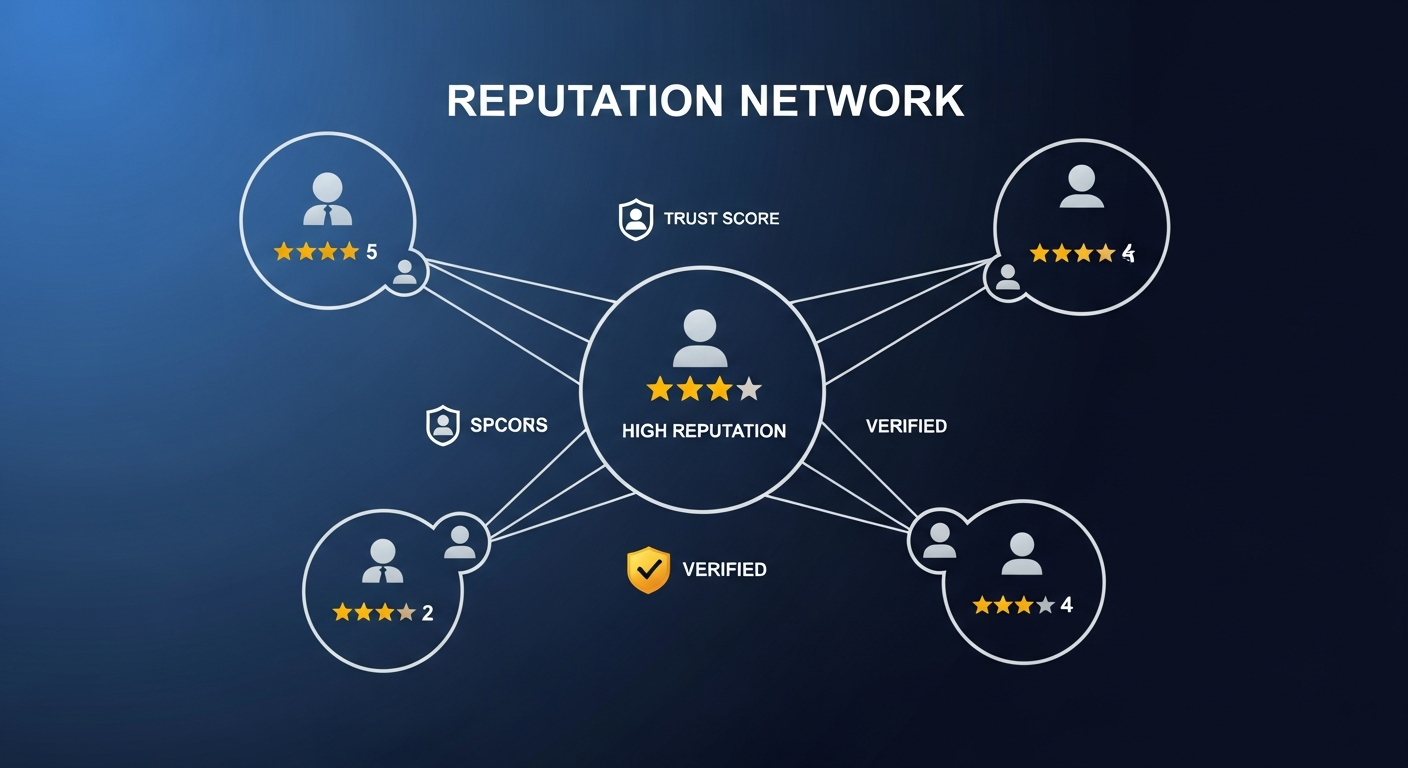
Figure: Decentralized reputation network connecting users through trust
💡 Why Trustless Environments Need Reputation
The term "trustless" in blockchain doesn't mean "no trust needed." It means you don't need to trust any single party. Instead, trust is distributed across the network through cryptographic verification and economic incentives. Reputation adds another layer: while the blockchain ensures transactions execute correctly, reputation tells you whether you should enter the transaction in the first place. It's the difference between knowing a contract will execute (trustless guarantee) and knowing the counterparty is reliable (reputation signal).
Reputation as Economic Infrastructure
Economists estimate that trust accounts for a significant portion of GDP in developed nations. Countries with higher levels of institutional trust have stronger economies, lower transaction costs, and more complex supply chains. In the blockchain world, reputation serves this same economic function — it's not just a nice-to-have feature, it's fundamental infrastructure that enables more sophisticated economic activity.
Kenostod's reputation system solves the trust problem by creating a transparent, tamper-proof, on-chain record of every user's behavior — a decentralized credit score built from real economic activity. Unlike centralized platforms that can modify, censor, or delete reputation data, Kenostod's record is permanent and controlled by no single entity.
The History of Trust & Reputation Systems
Trust systems have evolved dramatically through human history, and understanding this evolution reveals why blockchain-based reputation is such a significant innovation.
Ancient Trade Networks (3000 BCE – 1500s)
The earliest trade networks relied on personal reputation within small communities. In ancient Mesopotamia, merchants used clay tablets to record debts and transactions — essentially the first "on-chain" reputation records, permanently baked into clay. The Silk Road (the historical one, not the darknet market) relied on networks of trusted intermediaries called caravanserais, where a merchant's reputation traveled faster than their goods.
Medieval European trade guilds served as reputation guarantors. A guild mark on goods was a brand promise — if the goods were substandard, the entire guild's reputation suffered, creating collective accountability. This is conceptually similar to how staking-based reputation systems work: you put something valuable at risk to guarantee your behavior.
3000 BCE – Mesopotamian Clay Tablets
First recorded debt and transaction records. Permanent, physical "on-chain" data.
200 BCE – Roman "Fides" System
Roman merchants operated on "fides" (good faith). Breaking trust meant social and economic exile.
1200s – Medieval Trade Guilds
Guild marks as brand promises. Collective reputation with mutual accountability.
1600s – Hawala Networks
Islamic banking used trust-based money transfer without physical movement of funds. Pure reputation.
Institutional Trust (1800s – 1990s)
The Industrial Revolution created a need for trust at scale. People could no longer rely on personal knowledge of every merchant. This gave rise to institutional trust intermediaries:
Credit Bureaus (1841 – Present)
The Mercantile Agency (later Dun & Bradstreet) was founded in 1841 to aggregate information about businesses' creditworthiness. Today, FICO scores (created 1989) reduce a person's entire financial history to a single number between 300-850. This centralized model has enormous power — and enormous problems:
- The 2017 Equifax breach exposed personal data of 147 million Americans
- Credit scores contain errors affecting 1 in 5 consumers (FTC study)
- The system is opaque — most people don't understand how their score is calculated
- Access is controlled by three private companies with little accountability
- 1.7 billion people worldwide are "credit invisible" — they have no credit history at all
Better Business Bureau (1912 – Present)
The BBB attempted to create trustworthy business ratings, but its "pay-to-play" model (businesses pay for accreditation) created perverse incentives. Investigations revealed that unaccredited businesses could receive low ratings regardless of quality, while accredited (paying) businesses received higher ratings. A cautionary tale about centralized reputation systems.
Throughout history, reputation systems follow a pattern: they start as community-based and trustworthy, then scale to institutions that become powerful intermediaries, and eventually those intermediaries become gatekeepers who extract rent from the system. Blockchain-based reputation breaks this pattern by removing the intermediary entirely.
Web2 Reputation Systems: Lessons Learned
The internet era created massive peer-to-peer marketplaces that required entirely new trust mechanisms. Web2 platforms became the most extensive reputation experiments in human history, providing valuable lessons for blockchain designers.
eBay's Feedback System (1995)
eBay pioneered online peer-to-peer reputation. After each transaction, buyers and sellers rate each other. This was revolutionary: for the first time, strangers could trade valuable items with confidence based on aggregated feedback from previous transactions. eBay's system proved that reputation capital has real economic value — sellers with higher ratings consistently commanded 8-12% higher prices for identical items.
However, eBay's system suffered from critical flaws:
- Feedback inflation: Over 99% of ratings were positive due to fear of retaliatory feedback
- Shill feedback: Fake accounts could boost ratings artificially
- Centralized control: In 2008, eBay unilaterally removed sellers' ability to leave negative buyer feedback, fundamentally altering power dynamics
- Non-portability: A seller's 20-year eBay reputation is worthless on Amazon, Etsy, or anywhere else
Uber & Lyft: Two-Sided Ratings (2009+)
Uber improved on eBay by making ratings mutual and mandatory — both parties rate each other after every ride. Key findings:
- Drivers below 4.6 stars risk deactivation — a 1-star difference can mean loss of livelihood
- Average rating is 4.8/5.0, demonstrating severe "ratings inflation"
- The system is effectively binary: acceptable (4.6+) or deactivated
- Uber controls the algorithm, threshold, and appeal process unilaterally
- Research found ratings correlated with racial and gender bias
Airbnb: Trust Through Reviews (2008+)
Airbnb's challenge was even harder than eBay's — convincing people to sleep in a stranger's home. Their reputation system includes detailed reviews, profile verification, and the Superhost program that rewards consistent excellence with visibility badges. Airbnb demonstrated that sufficient reputation can overcome even the highest trust barriers.
However, Airbnb's system also revealed problems: hosts could manipulate their rankings by deleting and relisting poorly-reviewed properties, and the platform's review removal policies were opaque and inconsistent.
Amazon Reviews: The Fake Review Crisis
Amazon's review system is perhaps the most cautionary tale. A 2020 investigation revealed that up to 42% of Amazon reviews may be fake or incentivized. A leaked database exposed over 200,000 people participating in organized fake review schemes. Amazon spends billions annually fighting this problem but continues to struggle because the economic incentive to fake reviews is enormous — a product moving from 4.0 to 4.5 stars can see a 20-30% sales increase.
Stack Overflow & Reddit: Contribution-Based Reputation
These platforms introduced contribution-based reputation. Your reputation comes not from purchases but from the quality of your contributions to the community. Stack Overflow's karma system is entirely based on peer assessment of knowledge, creating a meritocratic hierarchy. This model is closer to how blockchain reputation works — your score reflects the value you've contributed to the network.
| Platform | Rating Type | Key Strength | Key Weakness |
|---|---|---|---|
| eBay | Post-transaction | First P2P trust system at scale | Feedback inflation, centralized rule changes |
| Uber | Mutual mandatory | Strong behavioral incentives | Rating inflation, bias, centralized control |
| Airbnb | Detailed reviews | Overcame high trust barriers | Manipulation through relisting |
| Amazon | Product reviews | Massive scale, verified purchases | Epidemic of fake reviews |
| Stack Overflow | Contribution-based | Meritocratic, quality-focused | Elitism, barrier to newcomers |
Every centralized reputation system shares the same fundamental flaw: a single entity controls the data. They can modify ratings, ban users arbitrarily, sell favorable placement, or simply go out of business (taking all reputation data with them). When Yahoo shut down Yahoo Answers in 2021, 16 years of community knowledge and reputation was permanently lost. Your Uber driver rating, Amazon seller score, and LinkedIn endorsements are not yours — they belong to the platform.
How Blockchain Reputation Differs
Blockchain-based reputation systems represent a paradigm shift from Web2 approaches. The core differences aren't just technical — they fundamentally change the power dynamics between users and platforms.
Immutability: The Permanent Record
Once a reputation event is recorded on the blockchain, it cannot be altered, deleted, or censored by anyone — not the platform, not the rated party, not even a government. This creates true accountability. On eBay, a seller who receives a devastating 1-star review might negotiate with eBay support to remove it. On Kenostod, that rating lives forever on-chain. This permanence makes every interaction meaningful and creates powerful behavioral incentives.
The flip side of immutability is that mistakes are also permanent. If someone receives an unfair rating, there's no customer service to appeal to. This is why Kenostod's time-decay mechanism is so important — old ratings gradually carry less weight, allowing users to recover from past negative interactions through sustained positive behavior.
Portability: Your Reputation Travels With You
In Web2, your reputation is locked inside each platform. A Uber driver with a perfect 5.0 rating starts from zero on Lyft. A top eBay seller has no reputation on Mercari. This is called the platform lock-in problem — platforms deliberately make reputation non-portable to prevent users from leaving.
Blockchain reputation is fundamentally portable. Your Kenostod reputation score is linked to your wallet address, which works across any application that reads the blockchain. A future DeFi lending protocol could check your Kenostod reputation to offer you better loan terms. A DAO could verify your trustworthiness before granting governance rights. Your reputation becomes a portable asset that you carry across the entire Web3 ecosystem.
Decentralization: No Single Point of Control
In centralized systems, the platform is the god of reputation. Facebook can shadow-ban you. Amazon can suppress your reviews. Uber can deactivate your account. In a decentralized system, no single entity controls the reputation data. The rules are encoded in smart contracts that execute autonomously — they can't be bent for political reasons, commercial interests, or executive whims.
Transparency: Open-Book Reputation
FICO scores are calculated using proprietary, opaque algorithms. You don't know exactly why your credit score is 720 instead of 750. On Kenostod, the reputation algorithm is fully transparent and verifiable. Anyone can audit the smart contract, verify any user's score calculation, and confirm that the same rules apply equally to everyone. This transparency eliminates the asymmetric information problem that plagues centralized credit systems.
| Property | Web2 (Centralized) | Web3 (Blockchain) |
|---|---|---|
| Data Ownership | Platform owns your data | You own your data (wallet) |
| Mutability | Platform can edit/delete | Immutable on-chain record |
| Portability | Locked to single platform | Portable across all dApps |
| Transparency | Opaque proprietary algorithms | Open-source, auditable code |
| Censorship | Platform can censor/ban | Uncensorable by design |
| Persistence | Lost if platform shuts down | Permanent as long as blockchain exists |
| Governance | Unilateral platform decisions | Community governance (DAOs) |
✓ The Ownership Revolution
The most profound difference is ownership. In Web2, you don't own your reputation — you rent it from the platform. In Web3, your reputation is a self-sovereign asset controlled by your private key. No platform migration, shutdown, or policy change can take it away from you. This is as revolutionary as the shift from feudal land tenure to property rights.
Decentralized Identity & Verifiable Credentials
Before we can build reputation, we need to understand identity in a decentralized context. In the traditional world, your identity is issued by authorities (government IDs, social security numbers). In blockchain, identity works fundamentally differently.
Decentralized Identifiers (DIDs)
A DID is a new type of identifier that is globally unique, cryptographically verifiable, and controlled entirely by the identity owner. Unlike a username on a platform (which the platform controls), a DID is yours forever.
DIDs are a W3C standard, meaning they're designed to work across different systems and blockchains. Your Kenostod wallet address is essentially a DID — a globally unique identifier controlled by your private key.
Verifiable Credentials (VCs)
Verifiable Credentials are digital proofs that someone attests something about you. Think of them as digital certificates that can be cryptographically verified without contacting the issuer.
In Kenostod, your reputation score is essentially a Verifiable Credential: it's a claim ("this wallet has a 4.7-star rating based on 150 transactions") that can be verified by anyone by checking the blockchain. No need to call a credit bureau or check with a central authority.
Self-Sovereign Identity (SSI)
The ultimate vision is Self-Sovereign Identity — where individuals fully own and control their digital identity without relying on any central authority. In this model:
- You hold your credentials (in your wallet)
- You choose what to share and with whom
- You can prove claims without revealing unnecessary information (using zero-knowledge proofs)
- No one can revoke your identity or reputation without your consent
💡 Web of Trust
The Web of Trust concept, originating from PGP encryption, creates a decentralized trust network where users vouch for each other. Instead of trusting a single authority, you trust people who are trusted by people you trust. Kenostod's reputation system creates a similar web: if you've had positive transactions with trusted wallets, your trustworthiness increases by association. The key difference is that Kenostod's web is backed by real economic activity (actual transactions), not just social vouching.
Kenostod's Reputation Model: Deep Dive
The Rating System
After any transaction, both parties can rate each other on a 1-5 star scale:
Rating Rules
- Transaction Required: You can only rate wallets you've actually transacted with. No drive-by reviews. This immediately eliminates the biggest problem with systems like Amazon reviews.
- One Rating Per TX: Each transaction allows exactly one rating per party. You can't rate the same transaction multiple times or change your rating later.
- Permanent Record: Ratings are stored on-chain forever. They cannot be edited or deleted by anyone, including the rated party or Kenostod's developers.
- Weighted Average: More recent transactions and larger transaction amounts carry more weight in the final score. A 1,000 KENO transaction counts more than a 1 KENO transaction.
- Time Decay: Older ratings gradually carry less weight, so your reputation reflects your current behavior, not something that happened years ago.
Reputation Score Calculation Algorithm
Kenostod's reputation score is calculated using a weighted exponential moving average (WEMA). This is more sophisticated than a simple average and produces fairer, more meaningful scores:
Why Each Component Matters
Transaction Amount Weighting prevents spam attacks. Without it, an attacker could send 1,000 transactions of 0.001 KENO each and generate a massive number of 5-star ratings cheaply. With amount weighting, those 1,000 micro-transactions collectively carry less weight than a single 100 KENO transaction.
Time Decay (Exponential) ensures that your reputation reflects who you are now, not who you were three years ago. A user who was unreliable in 2023 but has been consistently excellent throughout 2024-2025 should not be permanently penalized. The half-life of 231 days means that a rating from 8 months ago carries only half the weight of a fresh rating.
Mutual Rating prevents the power imbalance seen in systems like Uber, where only one party (the rider) holds meaningful rating power. Both transaction parties have equal ability to rate the experience.
Reputation Tiers
| Tier | Score Range | Min Transactions | Benefits |
|---|---|---|---|
| ⚪ New | No rating | 0 | Base access, standard fees |
| 🟡 Bronze | 2.0 - 3.4 | 5+ | Slightly increased FAL limits |
| ⬇️ Silver | 3.5 - 4.2 | 15+ | 10% fee discount, moderate FAL limits |
| 🔷 Gold | 4.3 - 4.7 | 50+ | 25% fee discount, high FAL limits, governance bonus |
| 💎 Diamond | 4.8 - 5.0 | 100+ | 50% fee discount, max FAL limits, 2x governance weight |
Reputation Benefits in the Kenostod Ecosystem
Flash Arbitrage Loan (FAL) Limits
Flash Arbitrage Loans (covered in detail in Course 4) allow users to borrow KENO for arbitrage within a single block. Higher reputation means higher borrowing limits:
- New users: Up to 500 KENO per FAL
- Bronze: Up to 2,000 KENO per FAL
- Silver: Up to 10,000 KENO per FAL
- Gold: Up to 50,000 KENO per FAL
- Diamond: Up to 200,000 KENO per FAL
Governance Weight & Transaction Fee Discounts
In Kenostod's governance system (Course 8), your voting power is enhanced by reputation. A Diamond-tier user's votes count double, giving experienced, trusted community members more influence over network decisions. Higher reputation also earns progressive fee discounts — over hundreds of transactions, this adds up to significant savings.
Trust Badges & Priority Processing
High-reputation wallets display trust badges visible to everyone in the network. When the network is congested, transactions from high-reputation users receive priority processing in the mempool.
✓ Economic Value of Reputation
Consider a Diamond-tier user who processes 100 transactions per month averaging 500 KENO each. With 50% fee discounts alone, they save approximately 250 KENO per month — 3,000 KENO per year. Add the higher FAL limits enabling larger arbitrage profits, and reputation easily generates thousands of KENO in value annually. Your reputation is quite literally a productive asset.
Sybil Attacks: The Greatest Threat to Reputation
A Sybil attack is when a single entity creates multiple fake identities to gain disproportionate influence. Named after the 1973 book "Sybil" about a woman with dissociative identity disorder, this is the fundamental challenge facing any reputation system — both centralized and decentralized.
How Sybil Attacks Work
Real-World Sybil Attack Examples
Amazon Fake Reviews (Ongoing)
Amazon has spent billions fighting fake reviews. In 2020, a leaked database revealed over 200,000 people were involved in a fake review scheme, receiving free products in exchange for 5-star reviews. Some sellers operated networks of hundreds of fake accounts, each with unique shipping addresses and payment methods to avoid detection. The economic incentive is clear: moving from 4.0 to 4.5 stars can increase sales by 20-30%.
Airbnb Ghost Listings (2019)
Investigations revealed that some Airbnb "superhosts" operated fake listing networks. They would create multiple listings for the same property, use fake reviews from accomplice accounts, and switch guests to inferior properties upon arrival. The legitimate-looking reviews made it nearly impossible for guests to identify the scam until they arrived.
Airdrop Farming in DeFi (2020-Present)
When blockchain projects distribute free tokens (airdrops) based on user activity, Sybil attackers create thousands of wallets to multiply their rewards. The Arbitrum airdrop in 2023 saw individual attackers operating 1,000+ wallets, collectively claiming millions of dollars in tokens meant for genuine users. LayerZero's 2024 airdrop attempted to combat this with "self-reporting" mechanisms where Sybil attackers could confess for reduced penalties.
Kenostod's Multi-Layered Sybil Defenses
- Transaction Fees: Every rating requires a real transaction with real fees. Creating 100 fake ratings costs real KENO, making attacks economically irrational.
- Amount Weighting: Small transactions contribute less to reputation. An attacker would need to risk large amounts of KENO, which defeats the purpose of the attack.
- Network Graph Analysis: The system detects suspicious patterns: wallets that only transact with each other, circular transaction patterns, or ratings that arrive in suspicious clusters.
- Minimum Transaction Threshold: Only transactions above a minimum amount generate rateable events, preventing spam microtransactions.
- Time Requirements: Building a credible reputation score requires months of consistent activity. Rushing the process triggers additional scrutiny and algorithmic flags.
The key insight is making Sybil attacks economically irrational. If it costs 500 KENO in transaction fees to build a fake reputation that can only steal 400 KENO before being detected, no rational attacker would bother. Kenostod's design ensures the cost of faking reputation always exceeds the potential benefit. This is called the cost-of-corruption threshold — the system is secure as long as attacking it costs more than the attacker can gain.
On-Chain vs Off-Chain Reputation
One of the most important design decisions in building a reputation system is where to store the data. This choice involves trade-offs between transparency, cost, privacy, and scalability.
On-Chain Reputation
On-chain reputation stores all reputation data directly on the blockchain. Every rating, every score calculation, and every tier change is recorded as a transaction.
- Advantages: Maximum transparency, immutability, composability (other dApps can read it), censorship resistance
- Disadvantages: Higher gas costs, less privacy (all ratings public), storage limitations, slower updates
- Examples: Kenostod reputation scores, on-chain attestations (EAS), Lens Protocol social graph
Off-Chain Reputation
Off-chain reputation stores data on external servers, databases, or decentralized storage networks (like IPFS or Arweave), with only a cryptographic hash or summary stored on-chain for verification.
- Advantages: Lower cost, better privacy (selective disclosure), faster updates, more storage capacity
- Disadvantages: Weaker immutability guarantees, dependency on external infrastructure, harder for other dApps to access
- Examples: Ceramic Network, Gitcoin Passport scores, off-chain attestation services
Hybrid Approaches
Many modern systems use a hybrid approach: store the most critical data (final reputation scores, tier changes) on-chain, while keeping detailed data (individual review text, metadata) off-chain with on-chain anchoring via cryptographic hashes.
| Factor | On-Chain | Off-Chain | Hybrid |
|---|---|---|---|
| Transparency | ✓✓✓ | ✓ | ✓✓ |
| Cost | High gas fees | Low/free | Moderate |
| Privacy | Low (all public) | High (selective) | Moderate |
| Composability | Excellent | Limited | Good |
| Immutability | Guaranteed | Trust-dependent | Core data guaranteed |
| Scalability | Limited | Excellent | Good |
💡 Why This Matters for Users
As a Kenostod user, the on-chain/off-chain distinction affects you directly. Your reputation score is on-chain, meaning any DeFi protocol, DAO, or marketplace can instantly verify your trustworthiness without asking Kenostod's permission. This composability is what makes blockchain reputation so powerful — your score becomes a building block that other applications can use, creating a network effect that makes your reputation more valuable over time.
ENS & Soulbound Tokens (SBTs)
Two of the most important innovations in blockchain identity and reputation are the Ethereum Name Service (ENS) and Soulbound Tokens (SBTs). Together, they form the foundation of what many call "Web3 identity."
Ethereum Name Service (ENS)
ENS is a decentralized naming system built on Ethereum. Instead of using a long hexadecimal wallet address like 0x1234...abcd, you can register a human-readable name like alice.eth. Think of it as DNS (Domain Name System) for the blockchain.
ENS names are more than just convenient labels — they serve as on-chain identities. When you see vitalik.eth, you know it's the real Vitalik Buterin because ENS ownership is cryptographically provable. This makes ENS names a form of reputation themselves: owning a recognizable ENS name signals legitimacy and permanence in the ecosystem.
Soulbound Tokens (SBTs)
Proposed by Vitalik Buterin, Glen Weyl, and Puja Ohlhaver in their 2022 paper "Decentralized Society: Finding Web3's Soul," Soulbound Tokens are non-transferable NFTs that represent credentials, achievements, and reputation.
Unlike regular NFTs (which you can buy, sell, or transfer), SBTs are permanently bound to a specific wallet address — your "soul." They can't be sold on a marketplace, which means they represent earned credentials rather than purchased ones.
SBT Use Cases
- Educational Credentials: A university issues an SBT diploma. It can't be bought or transferred — you had to actually earn it
- Professional Certifications: Completing Kenostod Academy courses could issue SBTs proving your blockchain knowledge
- Reputation Badges: Achieving Diamond-tier reputation could mint an SBT that proves your long-term trustworthiness
- Governance Participation: SBTs could prove you've participated in DAO votes, qualifying you for future governance roles
- Credit History: Your on-chain lending and repayment history as non-transferable proof of creditworthiness
SBTs vs Traditional NFTs
| Property | Regular NFT | Soulbound Token (SBT) |
|---|---|---|
| Transferable | Yes (can sell/trade) | No (permanently bound) |
| Represents | Ownership of digital assets | Credentials, achievements, reputation |
| Economic Model | Speculative/collectible | Non-financial, meritocratic |
| Sybil Resistance | Low (can buy reputation) | High (must earn credentials) |
| Identity Link | Weak (can resell) | Strong (bound to soul) |
How This Connects to Kenostod
Kenostod's reputation system naturally aligns with the SBT vision. Your reputation score is already non-transferable (it's tied to your wallet's transaction history) and earned through real activity. Future Kenostod updates could formalize this by issuing SBTs for reputation milestones:
"Diamond Achiever" — SBT issued when reaching Diamond tier (4.8+ stars, 100+ transactions). Non-transferable proof of sustained trustworthy behavior. Could unlock premium features across the entire Web3 ecosystem, not just Kenostod.
Reputation in DeFi: Under-Collateralized Lending & Beyond
Decentralized Finance (DeFi) is perhaps the most impactful application of blockchain reputation. Today's DeFi is almost entirely over-collateralized — to borrow $100, you must lock up $150 or more in collateral. This is extremely capital-inefficient. Reputation-based DeFi aims to change this fundamental limitation.
The Over-Collateralization Problem
In traditional finance, your credit score allows you to borrow money with little or no collateral. A mortgage requires only 3-20% down payment because the bank trusts your repayment based on your credit history. In DeFi, there's no credit score, so protocols demand 150-200% collateralization:
Aave Credit Delegation
Aave, the largest DeFi lending protocol, pioneered credit delegation — a mechanism where a depositor can delegate their credit line to another user. The delegator's collateral backs the borrower's loan, essentially vouching for them.
This is one of the first real-world implementations of reputation-adjacent DeFi. While current credit delegation requires a direct trust relationship (you delegate to someone you know), future versions could use on-chain reputation scores to enable delegation to strangers with proven track records.
How It Works
- Depositor deposits ETH into Aave and earns interest as normal
- Delegation: Depositor approves a specific borrower to use their credit line via smart contract
- Borrowing: The approved borrower takes a loan using the delegator's collateral
- Repayment: Borrower repays with interest. If they default, the delegator's collateral is liquidated
Under-Collateralized Lending Protocols
Several protocols are building reputation-based lending that requires less than 100% collateral:
| Protocol | Approach | Collateral Ratio | Reputation Source |
|---|---|---|---|
| Aave (Credit Delegation) | P2P vouching | 0% for borrower | Direct trust relationship |
| Goldfinch | Real-world credit assessment | 0-20% | Off-chain due diligence |
| Maple Finance | Institutional lending | 0% | KYC + credit analysis |
| TrueFi | Unsecured institutional | 0% | On-chain history + governance vote |
| Kenostod FAL | Flash arbitrage loans | Atomic (same-block) | On-chain reputation tier |
The Role of Reputation in DeFi Governance
Beyond lending, reputation is increasingly important in DeFi governance. Protocols like Compound and Uniswap use token-weighted voting, which means wealthy users have more governance power. Reputation-weighted governance offers an alternative: your voting power reflects your contributions and trustworthiness, not just your token holdings.
Kenostod's governance system (Course 8) already implements this: Diamond-tier users receive 2x voting weight, ensuring that long-term, trusted community members have stronger voices in protocol decisions.
💡 Why This Is Revolutionary
If blockchain reputation enables even a 20% reduction in required collateral across DeFi, it would unlock billions of dollars in capital efficiency. Currently, over $50 billion is locked as collateral in DeFi protocols. Reducing collateral requirements from 150% to 120% for reputable users would free up approximately $10 billion for productive use. Reputation isn't just about trust — it's about capital efficiency at scale.
Game Theory in Reputation Systems
Game theory is the mathematical study of strategic decision-making. It's fundamental to understanding why reputation systems work (or fail) by analyzing the incentives facing each participant.
The Prisoner's Dilemma
The classic game theory problem: two suspects are arrested. Each can either cooperate (stay silent) or defect (betray the other). If both cooperate, both get light sentences. If one defects while the other cooperates, the defector goes free while the cooperator gets a heavy sentence. If both defect, both get moderate sentences.
In a one-shot game, the rational strategy is to defect (cheat). But in a repeated game (like ongoing transactions on Kenostod), cooperation becomes rational because your reputation from previous rounds affects future opportunities. This is called the shadow of the future — the future consequences of today's actions change today's optimal strategy.
Reputation as a Repeated Game
When transactions are repeated and reputation is tracked, the calculus changes dramatically:
The Nash Equilibrium in Reputation
A Nash Equilibrium is a state where no player can improve their outcome by unilaterally changing their strategy. In Kenostod's reputation system, the Nash Equilibrium is universal honest behavior, because:
- If everyone is honest, any individual who cheats is immediately punished (low rating, higher fees, reduced access)
- If some people cheat, the honest majority still benefits more in the long run
- The cost of cheating (reputation damage) always exceeds the one-time gain from dishonesty
Mechanism Design: Reverse Game Theory
Mechanism design is "reverse game theory" — instead of analyzing existing games, you design the rules to produce the desired outcome. Kenostod's reputation system is a carefully crafted mechanism where the rules (transaction-based ratings, time decay, amount weighting) are specifically designed so that the rational self-interested strategy aligns with the socially optimal strategy (honest behavior).
The Tit-for-Tat Strategy
Robert Axelrod's famous 1984 tournament showed that Tit-for-Tat — cooperate first, then mirror what the other player does — is the most effective strategy in repeated games. Kenostod's rating system enables this naturally: start by treating new wallets fairly, reciprocate good behavior with good ratings, and punish bad behavior with poor ratings. The system creates a virtuous cycle where cooperation begets cooperation.
💡 Why This Matters
The genius of a well-designed reputation system is that it doesn't require people to be altruistic. It just requires them to be rational. By making honest behavior the most profitable long-term strategy, the system harnesses self-interest to produce cooperative, trustworthy outcomes. You don't need to trust that people are good — you just need to trust that they can do math.
Comparison of Reputation Models
Different blockchain projects approach reputation differently. Understanding these models helps you appreciate Kenostod's design choices and the broader landscape of trust systems.
Stake-Based Reputation
Users lock tokens as collateral ("stake") to signal trustworthiness. If they behave badly, their stake is "slashed" (partially or fully destroyed).
- Pros: Strong economic deterrent against bad behavior; quantifiable risk; easy to understand
- Cons: Plutocratic (wealthy users automatically have more "reputation"); doesn't measure actual behavior quality; capital-intensive
- Examples: Ethereum 2.0 validators (32 ETH stake), Chainlink oracle operators, Cosmos validators
Transaction-Based Reputation (Kenostod's Model)
Reputation is built from actual transaction history and peer ratings.
- Pros: Measures actual behavior; reflects real-world interactions; harder to fake; meritocratic
- Cons: New users start with no reputation (cold start problem); ratings can be subjective; requires active participation
- Examples: Kenostod, OpenBazaar, Particl
Vouching / Social Recovery
Existing trusted members vouch for new users, essentially lending them reputation.
- Pros: Solves cold start problem; creates social accountability; natural network effects
- Cons: Vulnerable to collusion; can create echo chambers; reputation inheritance is problematic
- Examples: BrightID, Proof of Humanity, Status network
Proof of Personhood
Systems that verify each account represents a unique real human, preventing Sybil attacks at the identity level.
- Pros: Completely prevents Sybil attacks; enables true one-person-one-vote; strongest identity guarantee
- Cons: Privacy concerns; technically challenging; can exclude people without required technology; centralization risk
- Examples: Worldcoin (iris scanning), Gitcoin Passport (multi-source attestation), Idena (AI tests)
Attestation-Based Reputation
Third parties issue cryptographic attestations about a user's credentials, behavior, or achievements.
- Pros: Flexible, composable, privacy-preserving (with ZK proofs); bridges Web2 and Web3
- Cons: Relies on attestor trustworthiness; attestation quality varies; standardization challenges
- Examples: EAS (Ethereum Attestation Service), Verax, Clique
| Model | Sybil Resistance | Cold Start | Privacy | Fairness | Cost |
|---|---|---|---|---|---|
| Stake-Based | High | Easy (just stake) | Good | Low (favors wealthy) | High |
| Transaction-Based | High | Hard | Good | High (meritocratic) | Moderate |
| Vouching | Medium | Easy | Good | Medium | Low |
| Proof of Personhood | Very High | Easy | Low | Very High | Varies |
| Attestation-Based | Medium-High | Moderate | High (ZK) | High | Low |
The Future of Decentralized Identity & Reputation
Decentralized identity and reputation are still in their early stages, but the trajectory is clear. Several converging trends will reshape how trust works in the digital economy over the next 5-10 years.
Cross-Chain Reputation
Today, your reputation on Kenostod doesn't automatically transfer to Ethereum mainnet or Solana. Future systems will enable cross-chain reputation aggregation — your reputation from multiple blockchains combined into a unified trust profile. Protocols like LayerZero and Axelar are building the cross-chain messaging infrastructure that will make this possible.
AI-Enhanced Reputation Analysis
Machine learning will enhance reputation systems by detecting sophisticated Sybil attacks, identifying behavioral patterns that simple algorithms miss, and providing nuanced reputation assessments beyond a single numeric score. Imagine an AI that can analyze your entire on-chain history and produce a multi-dimensional trust profile: reliability (do you complete transactions?), speed (how fast do you settle?), and fairness (are your ratings consistent with community norms?).
Privacy-Preserving Reputation (ZK Proofs)
Zero-knowledge proofs will revolutionize reputation by allowing users to prove reputation claims without revealing underlying data. For example:
- "I have at least Silver-tier reputation" without revealing your exact score
- "I've completed 50+ transactions" without revealing any transaction details
- "My average transaction size exceeds 1,000 KENO" without revealing specific amounts
- "I've never been rated below 3 stars" without revealing individual ratings
This solves the privacy paradox: maximum reputation utility with minimum information disclosure.
Decentralized Identity Standards
The W3C's DID and Verifiable Credential standards, combined with emerging standards from the Decentralized Identity Foundation (DIF), are creating an interoperable identity layer that works across blockchains, platforms, and even traditional institutions. Your Kenostod reputation could eventually be verified by a bank, employer, or government agency through standardized protocols.
Reputation DAOs
Future reputation systems may be governed by Reputation DAOs — decentralized autonomous organizations specifically designed to maintain and evolve reputation protocols. These DAOs would vote on parameter changes (like time-decay rates), dispute resolutions, and system upgrades, ensuring that no single entity controls the reputation infrastructure.
Imagine a world where your on-chain reputation follows you everywhere: better DeFi loan rates, DAO voting rights, marketplace trust badges, employment verification, and even real-world benefits — all from a single, self-sovereign, privacy-preserving identity that you fully control. No credit bureau, no platform lock-in, no gatekeepers. This is what Kenostod and the broader Web3 ecosystem are building toward. We're not there yet, but the foundations are being laid today.
Real-World Case Studies
Case Study 1: eBay's Reputation Revolution & Its Limits
Context: When eBay launched in 1995, the idea of buying from anonymous strangers online seemed absurd. Why would you send money to someone you'd never met for an item you'd never inspected?
What happened: eBay's simple feedback system (positive/negative/neutral) created sufficient trust for a $10+ billion annual marketplace to emerge. Research by economists showed that sellers with one extra percentage point of positive feedback could charge 8% higher prices. Reputation had measurable economic value.
The limitation: eBay's system was centralized. eBay could (and did) modify feedback rules, causing seller revolts. When eBay removed the ability for sellers to leave negative feedback for buyers (2008), it fundamentally changed the power dynamics of the marketplace. A decentralized system like Kenostod's prevents any single party from unilaterally changing the rules.
Kenostod lesson: Transaction-based reputation has proven economic value, but the governing entity must be decentralized to maintain trust in the system itself.
Case Study 2: The 2023 Arbitrum Airdrop Sybil Attack
Context: Arbitrum, an Ethereum Layer 2 scaling solution, distributed $ARB tokens to users based on on-chain activity. The airdrop was worth billions of dollars.
What happened: Sophisticated Sybil attackers created thousands of wallets months in advance, performing minimal qualifying transactions on each. One cluster of 1,496 wallets linked to a single entity claimed over $3 million in tokens. Despite Arbitrum's Sybil detection efforts, it's estimated that 20-30% of airdrop recipients were Sybil accounts.
The lesson: Simple activity-based metrics are easy to game. Kenostod's approach of requiring real transactions with real fees, combined with amount weighting and network analysis, provides much stronger Sybil resistance. You can't build reputation cheaply on Kenostod because every data point costs real economic value.
Case Study 3: China's Social Credit System — A Cautionary Tale
Context: China has been developing a nationwide Social Credit System since 2014 that assigns citizens a score based on financial behavior, social conduct, and even online activity.
What happened: While the system aims to promote trustworthiness, critics highlight severe problems: scores are opaque, criteria are unclear, and consequences can be extreme (travel bans, restricted access to education). The system is entirely controlled by the government with no user recourse or transparency.
The lesson: Reputation systems have enormous power over people's lives. The difference between a beneficial reputation system and an oppressive one lies in: (1) transparency of scoring criteria, (2) user agency and appeal mechanisms, (3) decentralized control, and (4) proportional consequences. Kenostod's on-chain reputation is fully transparent — you can verify exactly how every score is calculated and no single entity controls it.
Case Study 4: Uber's Rating System — The Inflation Problem
Context: Uber's mutual rating system (drivers and riders rate each other 1-5 stars after every ride) is one of the most widely used reputation systems in the world, with billions of ratings.
What happened: Research revealed that Uber ratings suffer from severe inflation — the average rating is 4.8/5.0, making meaningful differentiation nearly impossible. Drivers below 4.6 risk deactivation, creating anxiety about a system where a single 1-star rating can significantly impact their livelihood. The threshold effectively makes the system binary (acceptable vs. deactivated) rather than a meaningful spectrum.
The lesson: Kenostod's time-decay and amount-weighting help prevent rating inflation by ensuring that scores reflect genuine assessment rather than social pressure. The multi-tier reward structure (Bronze through Diamond) provides meaningful differentiation across the full rating spectrum.
Case Study 5: Goldfinch — Real-World Lending with On-Chain Reputation
Context: Goldfinch is a DeFi protocol that provides crypto loans to real-world businesses in emerging markets, primarily in Africa, Southeast Asia, and Latin America.
What happened: Goldfinch uses a combination of off-chain credit assessment and on-chain reputation to enable under-collateralized lending. "Backers" (community members) stake their capital to vouch for borrower pools, creating a decentralized credit assessment layer. The protocol has facilitated over $100 million in loans to real-world businesses.
The lesson: Reputation-based lending can work in DeFi, bridging the gap between fully collateralized protocols and traditional finance. However, the reliance on off-chain credit assessment creates centralization risks. Kenostod's fully on-chain approach avoids this dependency while building toward a future where on-chain history alone can serve as creditworthiness proof.
Written Exercises
Complete these exercises to reinforce your understanding. Take your time — thoughtful answers demonstrate true comprehension.
Exercise 1: Design a Sybil Attack
Imagine you wanted to fake a high reputation on Kenostod (for educational purposes only!). Describe step by step how you would attempt it, and then explain why each step would fail or be prohibitively expensive due to Kenostod's defenses.
Exercise 2: Web2 vs Web3 Reputation Comparison
Compare Kenostod's on-chain reputation system with a traditional FICO credit score AND a Web2 platform rating (like Uber or eBay). What are the advantages and disadvantages of each approach? In what ways is Kenostod's system more fair, and in what ways might it be less fair?
Exercise 3: Game Theory Scenario
A user with Gold-tier reputation (4.5 stars, 75 transactions) is offered a one-time deal to scam someone for 5,000 KENO. Using the concepts from the Game Theory section, calculate the approximate economic cost of the reputation damage versus the gain from cheating. Should they do it? Why or why not?
Exercise 4: SBTs and DeFi Reputation
Explain how Soulbound Tokens (SBTs) could be used to create an under-collateralized lending protocol. Describe what SBTs a borrower would need, how a lender would verify them, and what happens if the borrower defaults. Address the privacy implications of this system.
Exercise 5: Design Improvement
If you could add ONE feature to Kenostod's reputation system, what would it be and why? Consider the trade-offs (Sybil resistance, privacy, fairness, usability) and explain how your feature improves the system without introducing new vulnerabilities.
Hands-On Lab
Now it's time to put your knowledge into action! Complete ALL of the following tasks in the Kenostod blockchain simulator.
Lab Tasks:
- Task 1: View Reputation Scores — Navigate to the Reputation tab and examine the reputation scores of various wallets. Note the differences in tier levels and what they indicate.
- Task 2: Complete a Transaction & Rate — Send a transaction to another wallet and leave a rating. Observe how the rating is recorded on-chain.
- Task 3: Check Your Own Score — After receiving ratings from other wallets, check how your own reputation score has changed. Verify the weighted average calculation.
- Task 4: Analyze Rating Patterns — Look at multiple wallets' rating histories. Can you identify any patterns that might indicate genuine vs. suspicious activity?
- Task 5: Test Reputation Effects — Check how your reputation tier affects your available FAL limits and fee rates. Compare with wallets of different tiers.
Opens in the main platform. Complete all 5 tasks, then return here for the Final Exam!
Final Exam (12 Questions)
You must score at least 10 out of 12 correct (80%) to complete this course and earn your 250 KENO reward. Take your time and review the material if needed.
1. When can you rate another wallet on Kenostod?
2. What is a Sybil attack?
3. What prevents fake accounts from gaming Kenostod's reputation system?
4. What is a Soulbound Token (SBT)?
5. Why does Kenostod weight ratings by transaction amount?
6. Which is NOT a benefit of high reputation on Kenostod?
7. What is the main advantage of blockchain reputation over Web2 platforms like eBay or Uber?
8. In game theory, why does reputation make honest behavior rational?
9. How could reputation-based DeFi improve capital efficiency?
10. What is the "cold start problem" in reputation systems?
11. What role does time decay play in Kenostod's reputation scoring?
12. What is mechanism design in the context of reputation systems?
Kenostod Blockchain Academy © 2024
← Course 6 | Home | Course 8 →